One product, three names.
Feature terms change from page to page because nobody shared a glossary.
The fix: One glossary, style guide, and translation memory that every linguist on your account works from.
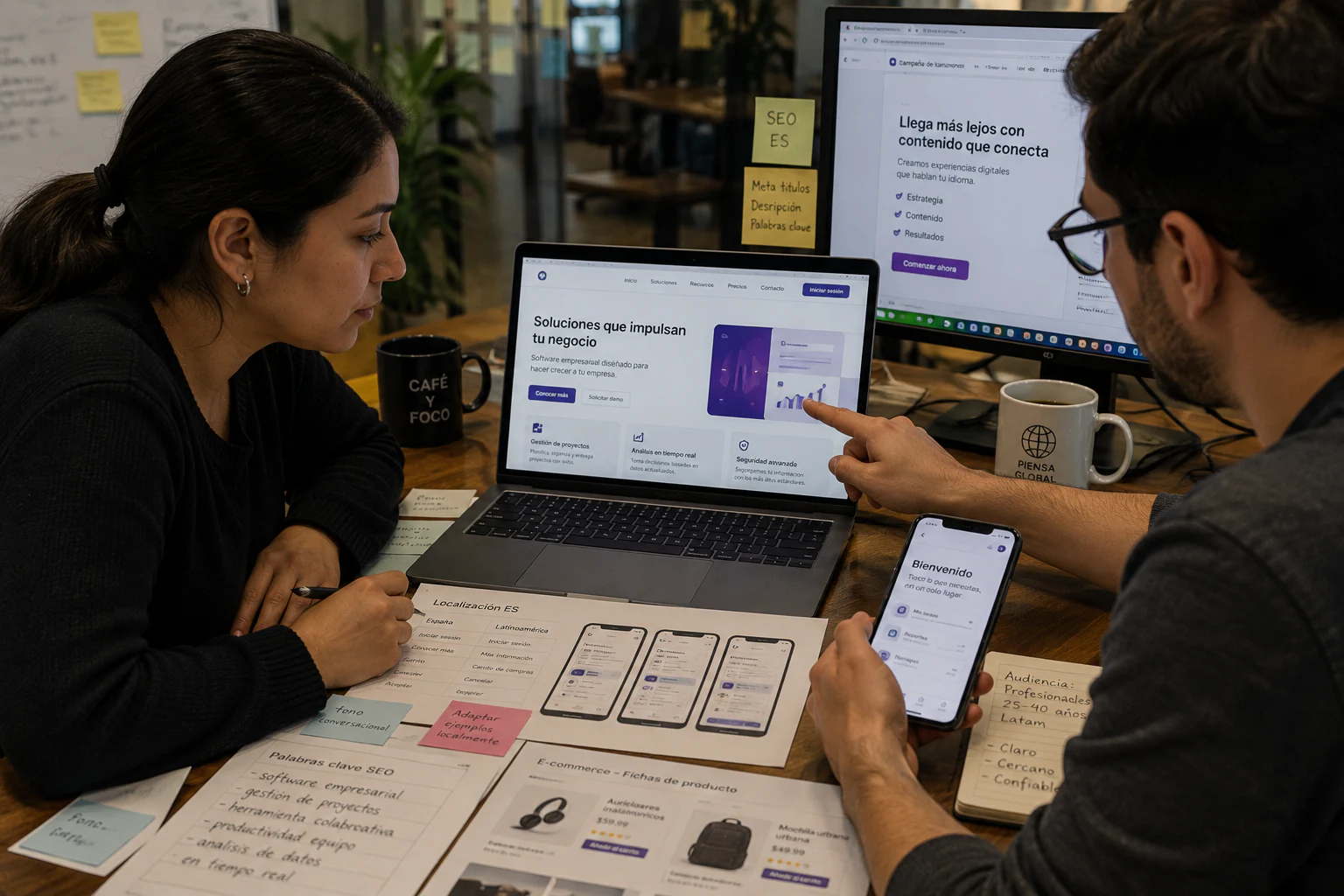
Translation, layout fixes, multilingual SEO, and testing all sit inside our website localization services. One team handles every language, so each version is ready for customers on launch day.





Your customers shop in their own language, and the research says so.
42% of EU internet users never buy online in a language other than their own, according to a 2011 European Commission survey.
76% of online shoppers prefer product information in their native language, according to a 2020 CSA Research study.
A word-for-word copy of the English site rarely closes that gap. Below are six places where translated websites lose customers, and how our team fixes each one.
Feature terms change from page to page because nobody shared a glossary.
The fix: One glossary, style guide, and translation memory that every linguist on your account works from.
German and French run longer than English, and fixed-width menus break on mobile.
The fix: Our team resizes menus, buttons, and forms and checks them on small screens before launch.
Nobody translated the title tags and meta descriptions, so Google shows English text to Spanish searchers.
The fix: Our team localizes every search-facing element for each country.
Without hreflang, search engines guess which version to show, and they guess wrong.
The fix: Our team plans and sets up hreflang across every language version.
Prices in dollars, postal code fields that refuse local formats, and error messages in English.
The fix: Our team localizes checkout and forms, then tests them on your staging site.
The English site moves on and the other languages keep last quarter’s offer.
The fix: A connected workflow that sends every source change to your linguists.
A localization manager will review your current language versions and point out what’s costing you orders.
Translation is only one part of the job. On every website localization project, Day Translations handles all five parts below, and your project manager decides how deep each one goes for your site.
Our linguists rework messaging, tone, idioms, and brand terms so each page reads as if it were written in that country. They also rewrite calls to action for local buying habits instead of carrying them over from English.
Our team checks banners, icons, graphics, and video for regional fit and translates any text inside them. Dates, times, currencies, units of measure, phone numbers, and addresses switch to local conventions.
Our team localizes title tags, meta descriptions, headings, and keyword targets for how each audience searches. We add hreflang tags and localized URLs at the same time, so every version is ready to index on day one.
Our work reaches into CMS templates, metadata fields, structured data, and elements that load on demand. Native connectors cover Adobe Experience Manager (AEM), Sitecore, Drupal, WordPress, Zendesk, and Salesforce, and a RESTful application programming interface (API) links custom stacks. Our team finds hard-coded strings outside the CMS during discovery, before they show up in a German navigation bar.
Send a sitemap or page list and get a price per language.
Here’s everything our team localizes on a typical website.
Domain names and URL structures
Page copy and navigation menus
Headlines, product descriptions, and landing pages
Metadata, title tags, and meta descriptions
Images, banners, graphics, and multimedia
Forms, checkout flows, and input fields
Buttons, calls to action, and validation messages
CMS fields and structured content blocks
Site search
Privacy pages, legal documents, and consent messages
Structured data and hreflang elements
Downloadable files and customer resources
If your site has an element that isn’t on this list, tell your project manager during discovery, and we’ll add it to your scope.
Your site architecture, release schedule, and IT capacity decide the setup. Our team reviews your infrastructure during discovery and recommends one option, with the reasons.
Our translation proxy serves localized pages from your existing site, so your developers make minimal changes to the code.
Suits: Many languages launched quickly, with continuous updates.
A lightweight script displays localized text on your current site as each page loads.
Suits: Companies running several regional versions with frequent page changes.
Our team duplicates and localizes the site structure directly, so you keep control of hosting, security, deployment, and country-specific changes.
Suits: Static sites and expansion into one new country.
Localization plugs into your CMS and publishing process, so new and edited pages move to translation without exports or copy-paste.
Suits: Sites with frequent updates and an established editorial team.
Need fast, subscription-based translation of a live site instead? Our website translation services cover that.
Search behavior changes from one country to the next, so translated English keywords miss local demand. Search engine optimization (SEO) work runs inside every localization project, from discovery to go-live.
For each target country, our team localizes:
Planning a market entry from scratch? Our multilingual SEO services team builds the keyword and content strategy before localization starts.
Four steps, with one project manager accountable for each. You know what happens at every stage and what you get at the end of it.
Your project manager reviews your site structure, CMS, templates, metadata, hard-coded strings, forms, and formatting rules. Technical constraints come out early, and you receive the setup, scope, timeline, and price in writing.
Native linguists adapt pages, visuals, and brand messaging for each target country, working from your glossary and translation memory. A second linguist revises every page under ISO 17100.
Reviewers check each language version in the live layout: spacing, navigation, forms, responsiveness, and user flow, across devices and browsers. Our localization testing team runs the functional checks.
The team checks localized metadata, keyword targeting, indexing signals, internal links, and hreflang before launch. After go-live, new and changed pages run through the same four steps.
Share your URL and target countries, and a project manager will recommend a setup, languages, and a launch date.
The workflow stays the same, but the pages that carry the risk change with the business model.
Product and category pages, size guides, filters, checkout, and shipping and returns pages, where one wrong currency or address field costs the order. Catalog and marketplace listings beyond the site go to our ecommerce translation team.
Software-as-a-service (SaaS) feature pages, pricing tables, sign-up flows, and help centers. Product terms stay identical between the marketing site and the app, so a trial user never meets two names for one feature. Cytellix, in the case study below, is one example.
Business-to-business (B2B) service pages, gated downloads, contact forms, and case studies. A buyer in Germany or Mexico fills in a form in their own language and reaches the right sales team.
Privacy policies, consent banners, terms of service, and account information get human translation and second-linguist revision on every page. Hospital and clinic sites go to our healthcare translation team.
Translated pages are one part of the handover. These assets make every later update faster.
Each language version live on your site, or ready on staging for your sign-off
A glossary and style guide per language, built with your team’s input
A translation memory holding every approved sentence, reused on future updates
hreflang, localized URLs, and localized metadata set up for each country
Quality assurance (QA) sign-off on layout, forms, checkout, and mobile for each language version
One named project manager for updates after launch
Marketing wants pages that sell. IT wants a vendor that won’t break the build. These five points answer both.

One team localizes copy, visuals, search elements, forms, and usability in one project. No one hands the work to a second vendor halfway through.
Proxy, JavaScript, native replication, or CMS-connected: the setup follows your infrastructure, so your developers don’t rebuild anything to suit a vendor.
Reviewers check pages inside your site’s visual environment, where exported files would hide the problems. They catch cut-off buttons, broken forms, and awkward reading flow, and our team fixes them before launch.
Every project follows ISO 17100:2015, the international standard for translation services: a qualified translator, then independent revision by a second qualified linguist. Legal, checkout, and high-visibility pages get the same two-step check.
ISO/IEC 27001:2022 certification and SOC 2 Type II cover the systems that hold your staging access and unpublished pages. The evidence sits in our Trust Center.
A localization project gives a vendor access to your CMS, staging environment, and pages that aren’t public yet. These controls protect them, and your IT or procurement team can request ISO certificates, SOC 2 documentation, and compliance records through the Trust Center.
ISO/IEC 27001:2022 certified, with an annual audit
SOC 2 Type II
Processing under EU data-protection rules, with a Data Processing Agreement (DPA) on request
AES-256 encryption at rest, TLS 1.3 in transit
Multi-factor authentication (MFA) and role-based access
Region-specific data storage that keeps EU data in the EU
Linguists and staff bound by nondisclosure agreements (NDAs)
Day Translations has been featured in Forbes, Inc, Entrepreneur, HuffPost, Fox News, and Lifehack.





A cybersecurity SaaS company had plenty of international visitors and very few international leads. Here’s what changed.
Cytellix runs the Cyber Watch Portal, a platform for cyber monitoring, risk management, and compliance used by small and mid-size companies, regulated industries, and government organizations. International traffic to its site kept rising, but few of those visitors became leads.
The whole site used technical English. Non-native readers struggled with the cybersecurity terms, the messaging didn’t match regional business expectations, and local search visibility was weak. Machine translation wasn’t an option, because it could distort compliance terminology.
CMS integration: Localization connected directly to the Cytellix CMS, so changing page sections and secure forms worked in every language
Cultural adaptation: Cybersecurity specialists and linguists rewrote messaging, technical terms, and calls to action for each region
Multilingual SEO: Regional keyword research, localized metadata, hreflang tags, and landing pages for each country
Localized user experience: Local contact details, regional number formats, layouts built for text expansion, and responsive design checks
Day Translations holds ISO 17100:2015 and ISO/IEC 27001:2022 certifications and a SOC 2 Type II report. We’re also a member of the American Translators Association, hold a GSA Schedule contract, and are BBB accredited with an A+ rating.
Straight answers to the questions marketing, ecommerce, and IT leads raise on a first call.
Still unsure? An expert answers 24/7/365.
Call an expertWebsite localization services adapt a website for a specific language and country. Beyond translating the text, they adjust content, visuals, formats, metadata, and user experience so the site reads as local to its users.
Translation converts text from one language to another. Localization includes translation and also adapts cultural references, visuals, SEO elements, navigation, formats, and functional parts of the site, such as forms and checkout, for each market.
Yes. Every project includes localized keyword targeting, metadata, title tags, headings, hreflang, and search alignment for each country.
Yes. Our team localizes product pages, category pages, checkout flows, forms, navigation, metadata, and customer-facing pages, and tests checkout in each language before launch.
Native connectors cover AEM, Sitecore, Drupal, WordPress, Zendesk, and Salesforce, and a RESTful API links custom stacks. For any other setup, your project manager reviews your CMS and publishing workflow during discovery and recommends a proxy, JavaScript, native, or CMS-connected option.
You choose the workflow for each page type. Human translation with second-linguist revision under ISO 17100 suits legal, checkout, and high-visibility pages. Artificial intelligence (AI) translation with human editing suits high-volume, lower-risk pages such as help center articles.
Access sits inside an ISO/IEC 27001:2022 certified security program, with multi-factor authentication, role-based permissions, and NDAs for every linguist and staff member on your project.
Your project manager sets the timeline after technical discovery, based on site size, number of target languages, content complexity, technical structure, and testing scope. The schedule covers each step: translation, revision, in-context testing, SEO checks, and launch.
Reviewers check each language version inside your website for layout, spacing, navigation, forms, device responsiveness, and functional accuracy, then sign off before launch. Issues go back to the linguist or your developer with a screenshot and the exact page, so fixes don’t stall in email threads.
Cost depends on site size, word count, number of languages, setup type, and SEO scope. Our linguists translate repeated text such as navigation, footers, and product templates once, and translation memory reuses it on every page. A sitemap or page list is enough to start, and your project manager confirms scope and price in writing before work begins.
Whether you’re launching in one new country or keeping ten language versions current, your project manager plans the setup, languages, SEO, and testing before any translation starts.
Send your URL, target countries, and launch date.