Video Game Translation Services

Our video game translation services help studios and publishers localize dialogue, interfaces, voiceover, subtitles, and store pages. We scope assets, languages, and platforms before production starts.

  • ISO 17100:2015-Certified Translation Services
  • AES-256 at Rest
  • TLS 1.3 in Transit
  • MFA Enforced
  • ATA Corporate Member
  • ATC Associate Member

Get a Video Game Translation Quote

Tell us your languages, volume, and deadline.

Languages *
From
To
  • ISO 27001 Certified
  • NDA-Backed Confidentiality

Companies That Work with Us

Mahindra has used our French and Spanish translation services since 2015. Arcturus Marine Systems Inc. has used our Turkish and Spanish translation services since 2013.

These relationships establish company-wide language-service experience. They do not imply work on either company’s games. Our client portfolio records the services and dates behind each engagement.

Where Game Localization Creates Release Problems

Video game localization needs the same source control and approval discipline as the rest of production. Missing context sends questions back to developers. A late script change affects recording and subtitle timing. Unchecked text creates another round of screen fixes.

Our project manager checks these dependencies during scoping. The delivery plan distinguishes final assets from scenes under revision and routes creative questions to the responsible studio contact.

Speaker and Scene Context

Our linguists review dialogue against the speaker, scene, and character references. Screenshots and character notes explain who speaks, who listens, and what happens around the line.

For video game translation, our team distinguishes an action label from a status or item name. Reviewers use the string identifier to keep each context decision attached to the correct occurrence.

Terminology Consistency

Character names, abilities, factions, and item descriptions recur throughout a game. A glossary gives the team an approved reference. It also records the naming decision: preserve the original, transliterate it, or adapt its meaning.

Our glossary records why a name stays unchanged, uses transliteration, or takes an adapted form. Linguists use that explanation when an expansion adds a related item. Your narrative owner retains approval of invented terms.

In-Game Text Display

Video game localization includes reviewing wording in its actual location. A translation that reads correctly in a spreadsheet still needs a display check. A button might overflow, a subtitle might disappear early, or a variable might show in the wrong position.

The agreed test plan identifies the build and screens under review. Testers use the studio’s access instructions to reach branching scenes. Our delivery plan accounts for developer corrections and review of the changed build.

Source Changes and Revision Control

A revised line affects its translation, subtitle timing, recording, and test status. Our project records distinguish linguistic corrections from new creative preferences and identify the source version under review.

Our project manager tracks the deliverables affected by a source change. The recording brief and translated script stay tied to the same approved version, so audio production follows the current decision.

Align narrative, development, publishing, and procurement requirements before commissioning production.

Game Assets We Translate and Localize

Our video game translation covers six asset groups. The proposal identifies the files and outputs for each service. The project manager coordinates the source and approval references for each group.

  1. A writer in glasses marking up a printed game script for video game translation services, a fantasy character paused on the monitor beside him.

    Narrative and Character Dialogue

    Our linguists translate scripts, branching conversations, character descriptions, subtitles, and narrative text. Setting notes, relationships, and approved dialogue give them a reference for recurring characters and tone.

    Video game translation also addresses humor, idioms, and invented terminology. Our team records proposed adaptations beside the affected line. Your creative owner approves decisions that change characterization or story meaning.

  2. A localizer sitting on a floor cushion with a controller, checking a game on the screen with her laptop open beside it.

    UI Translation, Tutorials, and System Text

    User interface (UI) translation covers menus, prompts, tutorials, notifications, and system messages. Our linguists work against string identifiers (IDs), screen references, and length limits. Protected variables and tags stay distinct from player-facing wording.

    Our team translates player-facing fields in the agreed export. Your developer handles import requirements and checks the returned files against the build. Our software localization service covers related work beyond the game’s assets.

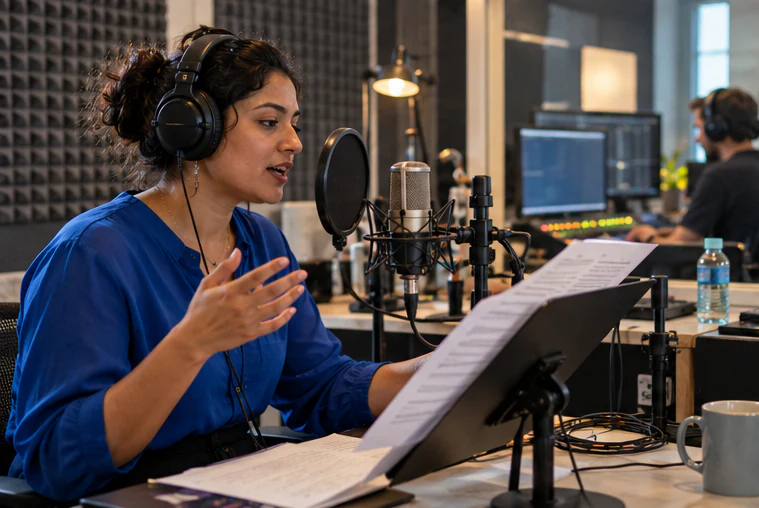
  3. A voice actor in headphones reading a script into a studio microphone, a sound engineer at the mixing desk behind her.

    Voiceover and Subtitles

    Our gaming service includes casting, voice direction, voiceover services, dubbing, and subtitling services. The audio team works from the approved script, character direction, pronunciation references, target accents, and timing requirements.

    Our project manager scopes the required audio outputs and file naming. The proposal separates subtitle delivery, mixing, and build integration. Our audiovisual translation service covers related script, recording, and subtitle production.

  4. An artist redrawing an in-game shop scene on a pen display, with concept art and color swatches pinned on the wall behind him.

    Visual Assets and Cultural Review

    Graphics, embedded text, symbols, and culturally specific references need review alongside the script. Video game localization identifies elements that need adaptation for the target audience. Your creative team approves changes to artwork, characters, or narrative details.

    Our team reviews editable artwork alongside preview files. The project plan identifies who implements each visual change and who checks the revised asset. Recommendations remain traceable through implementation and review.

  5. A reviewer highlighting text in a printed game guide, with tabbed binders stacked beside her.

    Manuals, Policies, and Player Information

    Game manuals, help files, terms of service, and privacy materials form a separate document scope. Their terminology should match the game wherever the same feature or item appears. Our linguists work from the approved policy version and terminology. Your legal team reviews legal meaning and applicability for the intended jurisdiction before approving the translated document.

  6. Two marketers comparing a game's store page on a phone with a grid of key art on a monitor.

    Store Pages and Launch Marketing

    Product descriptions, trailers, metadata, store listings, and advertisements need their own source files. Video game localization extends to these launch assets when the project includes them. Publishing teams approve the promotional wording separately from the game script.

    Valve’s Steamworks localization documentation distinguishes store-page translation from in-game language support. It also distinguishes between interface, subtitles, and full audio. Your listing should describe the language experience the shipped build provides.

Separate translation, audio, testing, and launch deliverables in your studio’s procurement scope.

Platforms, Languages, and Review Requirements

Our project manager distinguishes the engine, device, and storefront requirements. The handoff plan records the developer’s export format, import responsibilities, and playable build for review.

  • Engine Exports and File Delivery

    Our gaming service works with projects using Unity, Unreal, Godot, and CryEngine. Available formats include JavaScript Object Notation (JSON), Extensible Markup Language (XML), Portable Object (PO), spreadsheets, andcomma-separated values (CSV).

    Our team assesses the actual export and engine version before setting the handoff. The technical review checks string IDs, protected fields, and character limits. A representative file reveals details that a file extension alone does not show.

    The project manager agrees on the return format with your developer. Translation of exported strings has its own scope. Engineering inside the source project, custom formats, and interfaces receive separate technical assessment.

  • Language Coverage by Service

    Our project manager checks resource availability for video game translation, voice recording, and in-gametesting. Each service has its own language coverage. Regional pronunciation, terminology, and casting requirements inform the staffing plan.

    The proposal identifies the regional language variant and the available combination of text, audio, and review. Store-page translation and full in-game language coverage remain separate deliverables.

  • Requirements by Game Type

    Role-playing games (RPGs) need continuity for lore and branching dialogue. Strategy titles need stable names for units and actions. Visual novels place particular weight on character voice and scene context.

    Mobile games need readable prompts within the interface. Our mobile app localization service covers adjacent application requirements. The proposal distinguishes the game’s assets from a companion app or separate product.

  • Terminology, Cultural Decisions, and QA Approval

    Quality assurance (QA) needs a defined review boundary. Linguistic review checks wording and consistency. Localization quality assurance (LQA) checks that wording inside the game, including overflow, timing, formatting, and contextual fit.

    Our project manager records terms and creative approvals in the project plan. Review reports separate linguistic corrections, display changes, and functional defects. Each issue carries a string or build reference for the team responsible for the fix.

    Our ISO 17100:2015-certified translation services follow defined requirements for translator qualifications, project management, and revision by a second linguist.

How a Game Localization Project Runs

Our video game localization process has six stages. The project manager coordinates the source materials, approvals, and agreed outputs through each handoff. Your studio receives a delivery plan tied to its release requirements.

  1. Discovery and Scoping

    Our project manager reviews the game overview, source assets, languages, and release requirements. The team assesses the requested services before defining the engagement.

    For video game translation, our team checks source volume and representative strings with context. Audio and testing receive separate estimates. Procurement receives a proposal that distinguishes those services and their outputs.

  2. Glossary and Context Preparation

    Our project managers and native-⁠speaking linguists prepare naming conventions and terminology before translation. Your narrative owner supplies character references, screenshots, and explanations of invented concepts.

    Our linguists prepare the recurring terms for approval before translation. The shared glossary records chosen wording and relevant instructions. The project manager tracks open naming questions through resolution.

  3. Translation and Cultural Adaptation

    Linguists translate the agreed assets using the glossary and source references. Video game translation includes adapting idioms, dialogue, and marketing language to the target audience.

    Our linguists route creative questions to the studio contact responsible for tone and story. The answer stays with the affected asset, giving later reviewers a reference when another file uses the same concept.

  4. Voiceover and Audio Handoff

    Audio work follows script approval. Your studio provides character direction, pronunciation references, and timing requirements. Our audio team prepares the agreed voiceover or dubbing assets.

    The proposal sets revision rounds and delivery specifications. After a script change, our team assesses rerecording and subtitle work against the intended build. The project manager explains any effect on price or timing.

  5. Localization Testing

    Our gaming service includes linguistic and functional checks in real-game environments. The agreed video game localization test scope identifies the build, target locales, and screens or scenes to inspect.

    Testers use the developer’s build access and scene instructions. Our project manager coordinates issue reporting and retesting under the agreed scope. Reviewers inspect the corrected build after the developer implements a fix.

  6. Delivery and Post-⁠Launch Support

    Our team delivers the agreed files with their version references and approved terminology. The same release records provide context when an update changes an existing feature.

    Our gaming service covers patches, rolling updates, and post-⁠launch support. The project manager scopes downloadable content (DLC) against its own assets and approval dates. Each update has a defined service and delivery agreement.

Establish production handoffs, review responsibilities, and delivery requirements for your release teams.

Human Review and AI Production Options

Our gaming linguists review narrative context, terminology, and cultural adaptation. For video game translation, the agreed production method reflects the asset type: dialogue, short interface labels, technical messages, or recurring updates.

Our AI translation and localization service combines artificial intelligence (AI) with human review. The project manager confirms the production method for the agreed game assets.

Our team reviews proposed processing tools and data terms during scoping. The project agreement identifies permitted assets, human review, and any consent requirements for synthetic voice production.

Security for Unreleased Game Assets

  • Unreleased scripts, builds, recordings, and reference files need a confidentiality arrangement. Our gaming service uses nondisclosure agreements (NDAs). Our security architecture includes role-based permissions andmulti-factor authentication (MFA).

  • Our infrastructure uses the Advanced Encryption Standard (AES)-256 for stored data and Transport Layer Security (TLS) 1.3 for data in transit. The Trust Center provides security documentation for vendor review.

  • Our project manager coordinates the agreed transfer route and authorized access to the game’s assets. Project-specific retention, deletion, and external-tool terms cover translated files, recordings, and terminology records.

Project Evidence Behind the Service

Our documented audio engagement provides a specific example of multilingual voice production. Its scope covers voice commands for a technology product.

Case Study in Multilingual Voice Commands

Since 2016, Day Translations has worked with a Silicon Valley venture developing AI and deep learning products. Our voice talent produced more than 200 localized commands. The assignment required natural phrasing and the requested accents.

The recordings included Canadian French, Russian, Taiwanese Mandarin, Australian English, American Spanish, United Kingdom (UK) English, and Korean-accented English. Our voice-command case study describes the production requirements.

A video game localization audio brief needs its own character, performance, and delivery decisions. This case demonstrates multilingual voice work.

Game Localization Pricing and Project Scope

  1. Our project manager prices video game translation and video game localization by service. Text, recording, and in-game testing each have a defined scope. The proposal identifies the agreed assets, review work, and delivery requirements.

  2. Our estimate accounts for source volume, target languages, audio production, testing, and review rounds. Launch materials receive their own line of scope. The project manager checks which assets are final and which remain under revision.

  3. Procurement receives the included deliverables and exclusions beside the price. Our project manager assesses source additions, rerecording, and later updates separately. The delivery plan accounts for approvals, recording dependencies, and build access.

Video Game Translation Services FAQs

Compliance, credentials, turnaround, and cost — answered before you ask.

Still unsure? An expert answers 24/7/365.

Call an expert

Plan Your Studio’s Localization Scope

Studio localization managers, producers, publishing teams, and procurement leads receive one agreed scope and delivery plan. Our project manager coordinates translation, audio, testing, and confidentiality requirements around that plan. Day Translations provides video game translation and video game localization for the agreed release. Our proposal distinguishes launch work from later updates, so your teams assess the same services, responsibilities, and price.

Scope a studio or publisher engagement with release assets, testing requirements, and post-⁠launch work.

  • Hello
  • 你好
  • Hola
  • مرحبا
  • Olá
  • こんにちは
Carla is a Customer Support Representative dedicated to making multilingual communication seamless for healthcare, legal, government and global enterprises. She coordinates translation, localization and interpreting services in over 500 languages 24/7.Request a Project QuoteCarla Moxam