






Life Sciences Translation Services

Pharmaceutical sponsors, CROs, and medical device manufacturers use our life sciences translation services for informed consent forms, protocols, labeling, and safety reports. Subject-matter linguists translate each file, and a second linguist revises it under ISO 17100.

  • ISO 17100:2015 certified
  • ISO/IEC 27001:2022 certified

Get a Life Sciences Quote

Tell us your languages, volume, and deadline.

Languages *
From
To
  • ISO 27001 Certified
  • NDA-Backed Confidentiality

Pharmaceutical, CRO, device, and diagnostics teams that have worked with Day Translations and Day Interpreting:

  • Florida Cancer Specialists & Research Institute, a Day Translations client
  • American Red Cross, a Day Translations client
  • American Psychological Association, a Day Translations client
  • NYC Health + Hospitals, a Day Translations client
  • Empath Health, a Day Translations client

Common problems

Where Life Sciences Translation Slows a Program Down

Most translation problems in this industry aren’t about one bad sentence. They show up as a retranslated consent form, a term that changed between amendments, or a safety report stuck in a queue. Here’s where programs lose time, and what we do about it.

Consent Forms Translated Too Early

Sterling IRB advises sponsors to wait for IRB approval of the English ICF before translating. Even a minor change to the English version forces a full retranslation, because certification covers the whole document, so you pay for the entire ICF again.

How we handle it: Send us the approved version, and informed consent translation starts from final wording. When your IRB asks for a back translation, a third independent translator produces it, and every discrepancy is reconciled and documented for your submission.

Terms That Change Between Amendments

Protocol amendments, investigator brochure updates, and label changes keep coming for years. When each round goes to a different translator, the same adverse event ends up with two names, and a regulatory reviewer spots both.

How we handle it: Each sponsor gets a dedicated project manager and a linguist pool organized by therapeutic area. Your glossary and translation memory load before work starts, and once a sentence is approved, it’s reused in every later document, with version control on protocols and amendments.

Safety Reports on a Regulatory Clock

ICSRs, SUSARs, DSURs, and PSURs come with reporting deadlines that don’t move for a translation backlog.

How we handle it: Pharmacovigilance translation runs 24/7, so a case that lands on a weekend doesn’t wait for Monday. Our safety linguists work from MedDRA-aligned terminology databases in all major languages.

Raw Machine Output on Regulated Documents

AI-only translation looks cheap until something goes wrong. The 2026 Nimdzi 100 reports that buyers who used raw AI output on content previously judged “not for MT” saw “high-profile quality failures and hallucinations,” and went back to language providers for expert validation.

How we handle it: ICFs, labeling, protocols, and safety reports go to subject-matter linguists, with a second linguist revising each file. Machine translation post-editing is available for lower-risk content, and you decide where it applies.

Launches Across Many Markets

Under EU MDR, each Member State sets the language for device labels and instructions for use. A launch in a dozen countries means a dozen language requirements to meet on one schedule.

How we handle it: Our regulatory linguists work in dedicated regional teams covering North America, Europe, Japan, Asia-Pacific, and Latin America, on one centralized translation memory. Your IFU translation and EU MDR translation stay consistent in every market.

Why Day Translations

What Life Sciences Teams Get with Day Translations

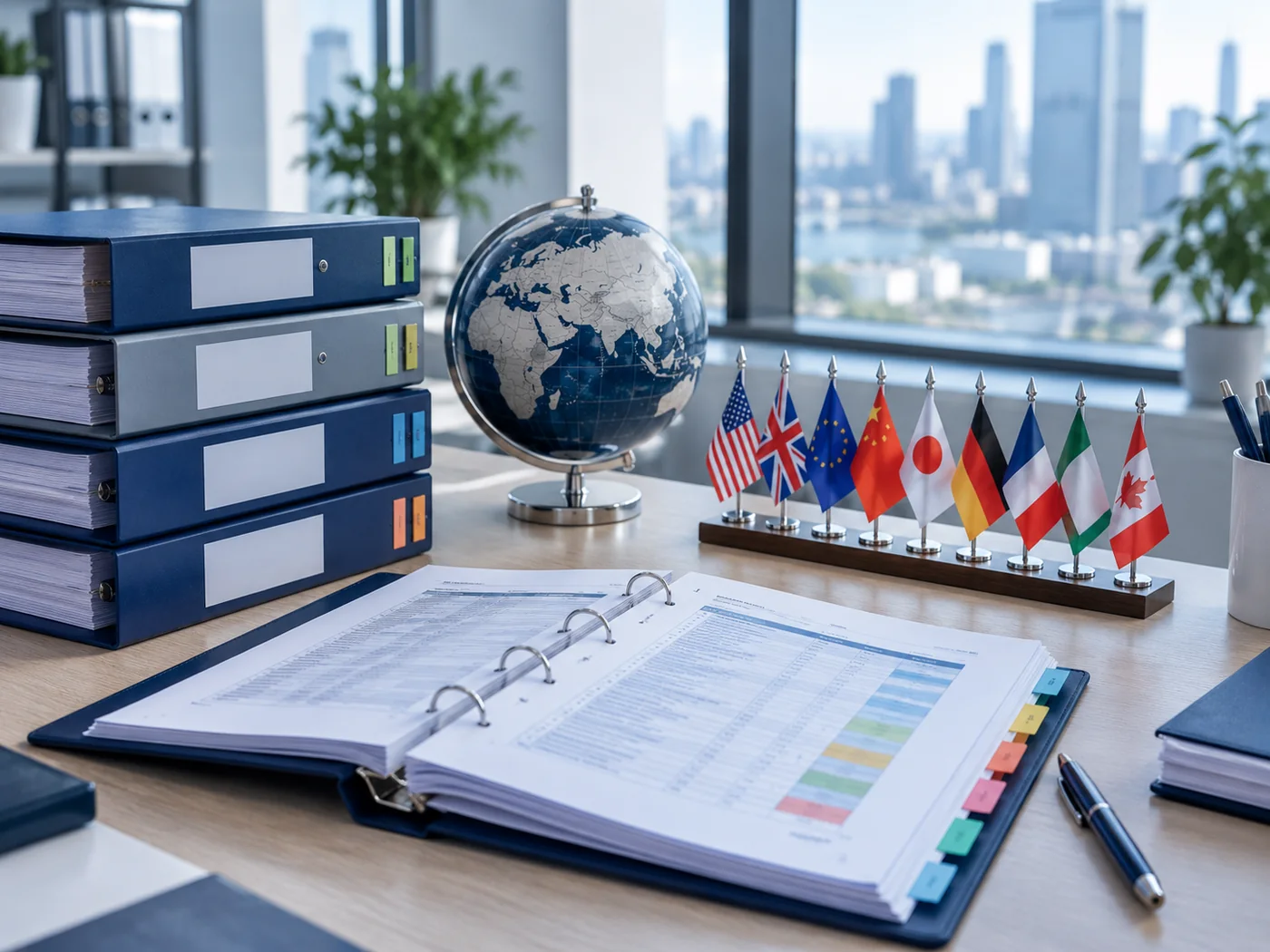
Stacked regulatory binders, a desk globe and a row of national flags beside an open tabbed binder, submissions translated for health authorities in every market.
  1. Life sciences specialists

    Our pharmaceutical translators hold advanced degrees in pharmacology, medicine, biochemistry, or regulatory affairs, and clinical work is matched by therapeutic areas, including oncology, rare disease, CNS, cardiovascular, and immunology.

  2. Submission-ready files

    Each finished file comes with a Certificate of Accuracy, an audit trail, and a translation memory update. Pharmaceutical projects run on FDA 21 CFR Part 11 compliant audit trails.

  3. One vendor for the portfolio

    Clinical, regulatory, safety, device, diagnostics, and interpreting work sit with one team, under one set of security controls.

  4. Security your procurement team can check

    ISO/IEC 27001:2022 certification, SOC 2 Type II, a BAA for HIPAA-covered work, and a DPA for GDPR.

Our Specializations

Life Sciences Translation by Program

Clinical research, drug development, genomics, diagnostics, devices, and regulatory affairs each come with their own regulators, document sets, and terminology. We maintain dedicated specialist teams for each area, with subject-matter expertise matched to the content and regulatory requirements.

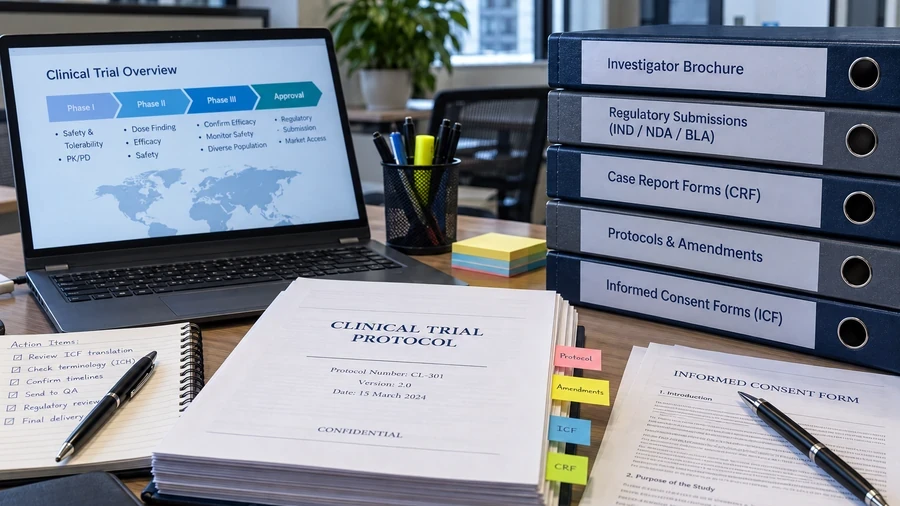
A clinical trial protocol and an informed consent form beside binders for case report forms and the investigator brochure, trial documents translated for every study site.

Clinical Trial Translation

Phase I to IV studies run by sponsors, CROs, and sites, with regulatory submissions for FDA, EMA, PMDA, and Health Canada.

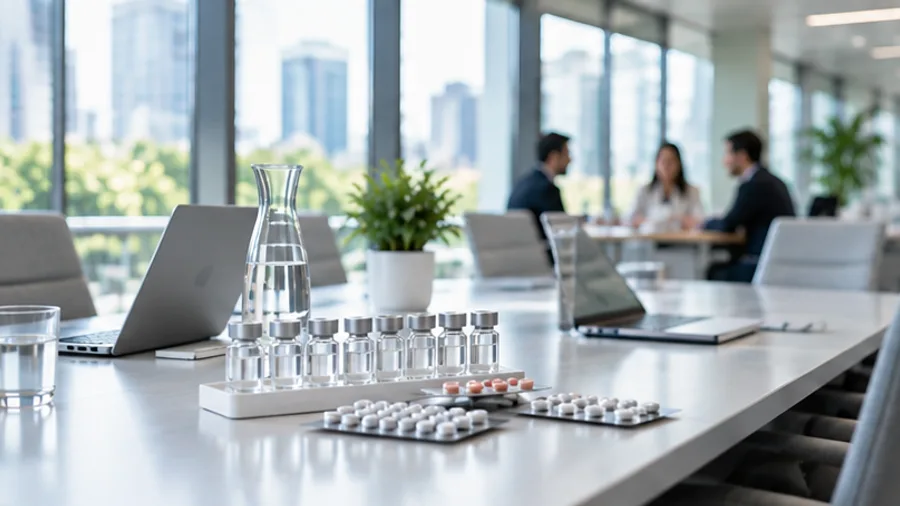
A conference table with laptops, glass vials and blister packs as colleagues meet behind it, a multi-market submission program run on shared terminology.

Global Regulatory Strategy

Multi-market submission programs run on centralized terminology and translation memory, with dedicated regional regulatory linguist teams.

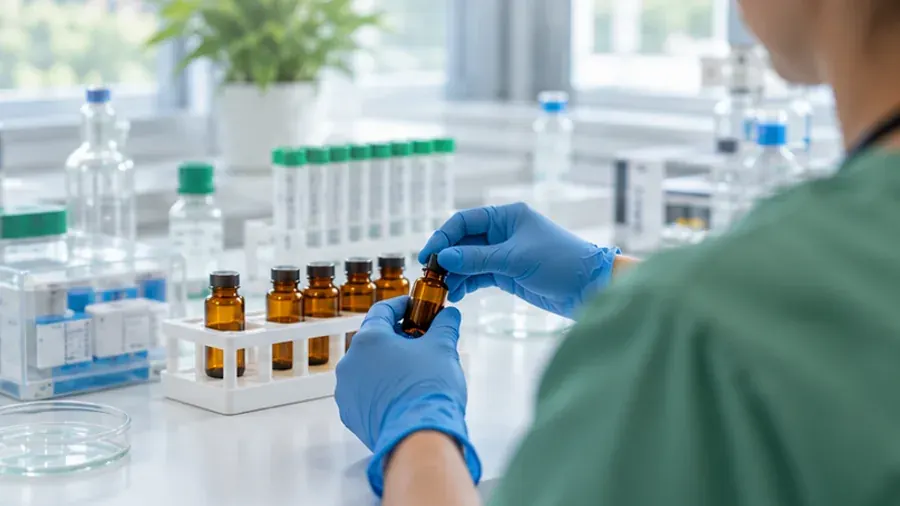
A technician in blue gloves lifting an amber vial from a rack on a lab bench, drug development whose IND, CTD and labeling documents we translate.

Pharmaceutical and Biotech Translation

Drug development from IND to NDA or BLA, including CTD dossiers and drug labeling.

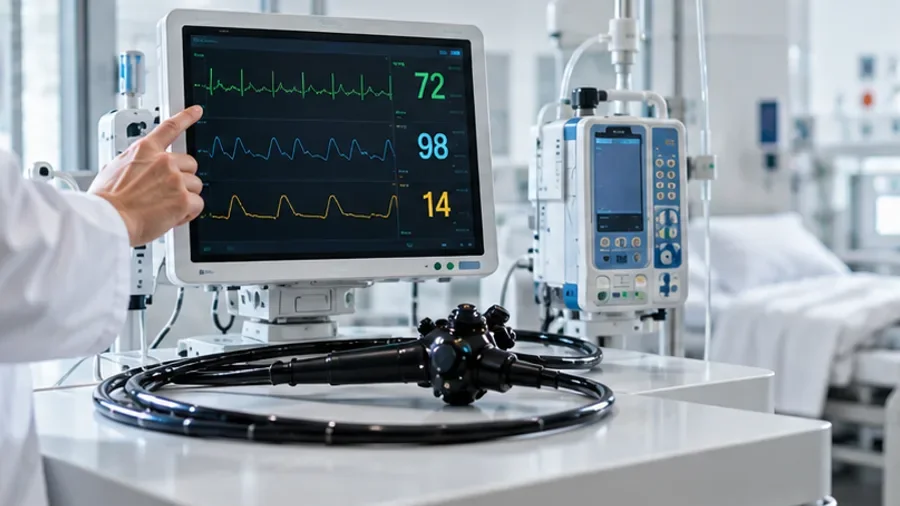
A clinician pointing at a patient monitor beside an infusion pump and a coiled endoscope, medical devices whose IFUs and EU MDR files we translate.

Medical Device Translation

510(k), PMA, and CE Mark files, including EU MDR translation for IFUs and post-market reports.

Barcoded specimen tubes and a pipette filling a microplate beside a microscope, diagnostic lab work whose IVD documents and SOPs we translate.

Diagnostics and Laboratory Translation

IVD manufacturers working to EU IVDR, with quality documents prepared for ISO 13485 systems.

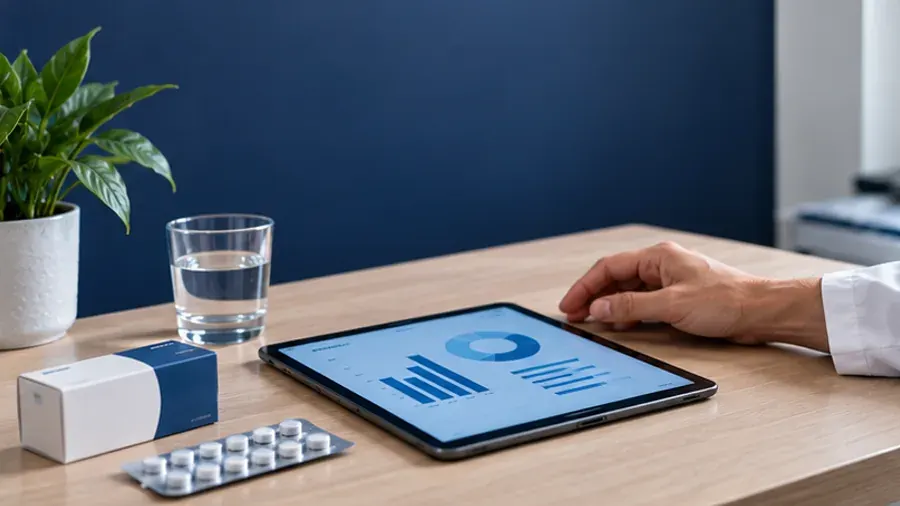
A hand beside a tablet of summary charts, a medicine carton and a blister strip on a desk, submission data translated for each health authority.

Regulatory Affairs Translation

Submission teams filing with FDA, EMA, PMDA, Health Canada, and ANVISA.

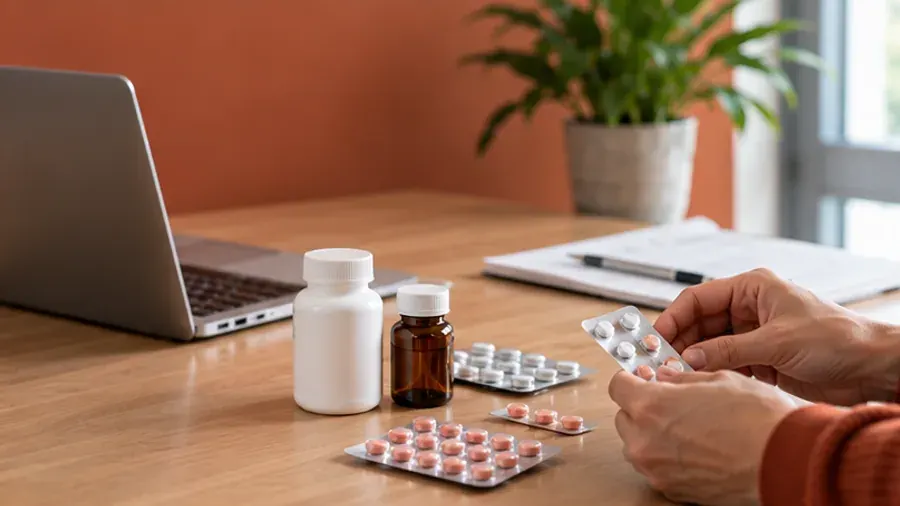
Hands checking a blister strip beside pill bottles and a laptop, the safety reports and case narratives we translate with consistent pharmacovigilance terms.

Drug Safety and Pharmacovigilance Translation

The same safety terminology in every periodic report and case narrative.

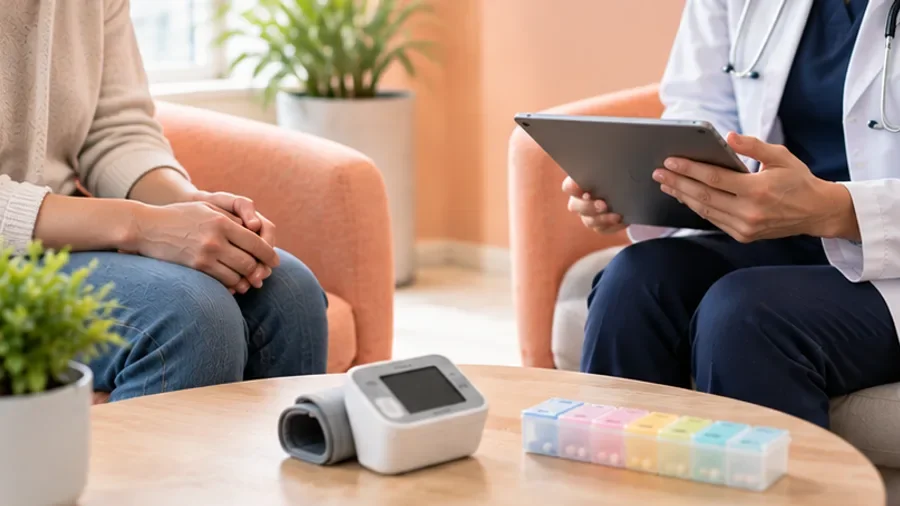
A clinician with a tablet sitting with a patient beside a blood pressure monitor and a pill organizer, a patient questionnaire validated for another language.

Linguistic Validation Services

Clinical outcome assessments that must measure the same concept in every country.

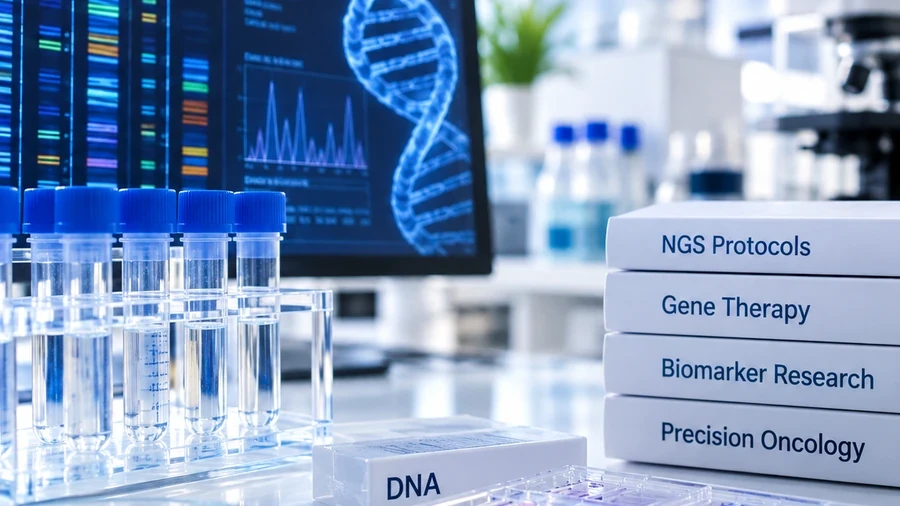
Sample tubes beside a monitor showing a DNA helix and binders labeled NGS Protocols and Gene Therapy, genomics filings and protocols we translate.

Genomics and Precision Medicine

NGS protocols, gene therapy filings, companion diagnostics, and precision oncology trials.

An anatomical heart model and a spine model beside an open medical atlas, the textbook and CME content we translate for medical publishers.

Medical Education and Publishing

Textbooks, CME content, clinical guidelines, and scientific papers for publishers and medical societies.

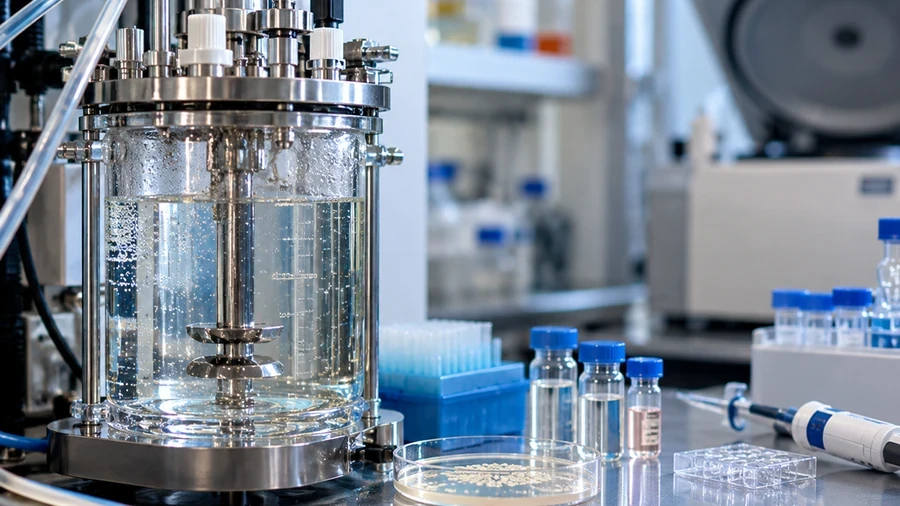
A benchtop glass bioreactor beside a petri dish, sample vials and a micropipette, the research protocols and manuscripts we translate for biotech teams.

Biotechnology Research

Protocols, grant applications, lab notebooks, and manuscripts from biotech companies, academic research centers, and government agencies.

Staff at a hospital nurses' station as a nurse in scrubs walks past, where patient records and discharge summaries need translating for patients.

Healthcare Translation

Hospital and patient communications, such as patient records and discharge summaries, sit with our healthcare translation team.

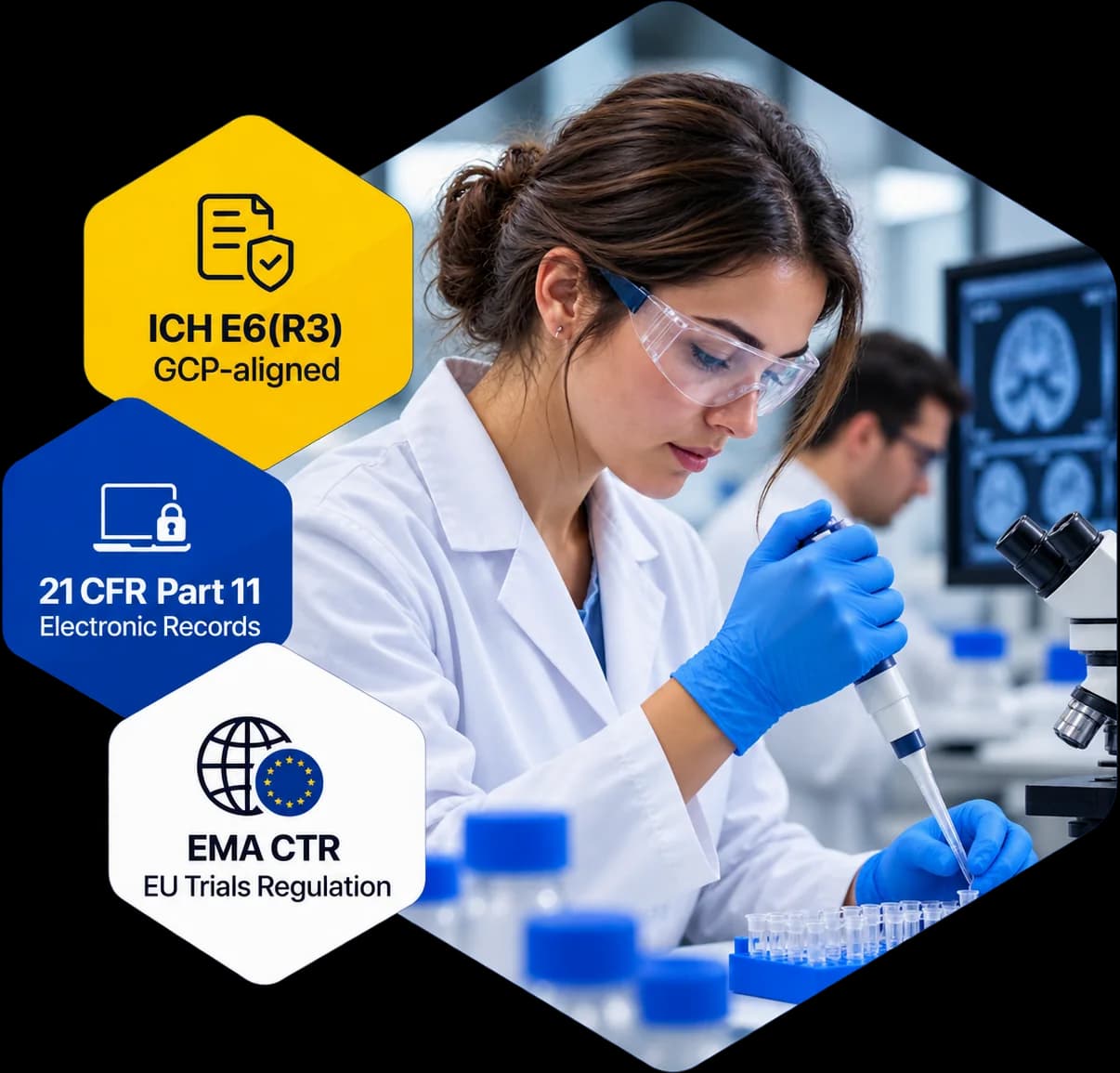
A scientist pipetting samples beside badges for ICH E6(R3) GCP alignment, 21 CFR Part 11 and EMA CTR, the frameworks our clinical document translation aligns to.
What We Translate

Documents We Translate from Protocol to Post-Market

Each stage of a program produces its own paperwork, and a protocol amendment needs different handling than a device label or a PSUR. Here’s what Day translates for sponsors, CROs, and device and diagnostics manufacturers, grouped by where each document ends up.

  1. Clinical Trial and Patient-Facing Documents

    • Protocols and amendments
    • Informed consent forms and subject information sheets
    • Investigator brochures
    • Case report forms and eCOA content
  2. Regulatory Submissions, Labeling, and Safety Reports

    • IND, NDA, and BLA submissions in CTD and eCTD format
    • Prescribing information, patient package inserts, and medication guides
    • Summaries of product characteristics (SmPCs) and patient information leaflets
    • Health authority correspondence and risk management documentation
    • Individual case safety reports (ICSRs) and suspected unexpected serious adverse reaction reports (SUSARs)
    • Development safety update reports (DSURs) and periodic safety update reports (PSURs)
  3. Device and Diagnostics Documentation

    • IFU translation for FDA, EU MDR, and global labeling requirements
    • UDI labeling
    • Clinical evaluation reports and post-market surveillance documentation
    • IVD labeling, laboratory SOPs, and assay development records

AI & Human Expertise

Where Machine Translation Fits in Regulated Content

Machine translation post-editing (MTPE) means a machine produces the first draft and a specialist linguist corrects it. Day offers it for lower-risk, high-volume content, and a specialist refines every draft.

ContentWorkflow
Informed consent forms, labeling, protocols, and safety reportsTranslation by a subject-matter linguist, then revision by a second linguist
Internal documents and selected marketing materialMTPE, refined by a specialist linguist

You choose the workflow for each content type, and the safeguards match the risk. Day’s approach to medical AI translation keeps a qualified linguist in the loop at every stage.

Linguistic Validation

Linguistic Validation for COA and PRO Instruments

A translated questionnaire is only useful if patients in every country read the question the same way. Our linguistic validation follows an ISPOR-aligned process for patient-reported, clinician-reported, and observer-reported outcomes:

  1. Instrument assessment

    An LV specialist reviews the instrument, languages, regulatory requirements, and study timeline.

  2. Forward translation

    Two independent translators each produce a version, and an expert committee reconciles them.

  3. Back translation

    An independent translator translates the reconciled version back for comparison with the original.

  4. Expert committee review

    A multidisciplinary committee checks conceptual equivalence and produces the pre-final version.

  5. Cognitive debriefing

    We interview 5 to 10 target-language patients to assess comprehension and cultural fit.

  6. Final version and dossier

    Findings are worked in, and a complete LV dossier is prepared for FDA or EMA submission.

For global trials, we harmonize versions across languages so scoring stays consistent, and the same process covers eCOA and ePRO versions.

Compliance & Certifications

Certifications We Hold and Frameworks We Align To

Procurement teams evaluating a life sciences translation company ask for two different things: the certificates a vendor holds, and the rules its workflows follow.

Certifications and Audits Day Holds

  • ISO 17100:2015

    The international standard for translation services, including independent revision by a second qualified linguist on every project.

  • ISO/IEC 27001:2022

    Information security management, audited every year by an accredited third-party body.

  • SOC 2 Type II

    Independent validation of security, availability, and confidentiality controls. A SOC 2 audit produces a report, not a certificate.

Frameworks our workflows align to.

“Aligned” means the workflow follows the framework’s requirements. It doesn’t mean a certificate exists.

  • HIPAA

    Handling of protected health information (PHI)

  • GDPR

    Protection of personal data

  • 21 CFR Part 11

    Electronic records, with Part 11 compliant audit trails on pharmaceutical projects

  • ICH E6(R3)

    Good clinical practice for clinical trial workflows

  • EU Clinical Trials Regulation

    Clinical trial documentation for EU submissions

  • EU MDR and IVDR

    Medical device and in vitro diagnostic submissions

Memberships and status

American Translators Association member, GSA Multiple Award Schedule contract holder, and BBB accredited with an A+ rating.

Project workflow

How a Life Sciences Translation Project Runs with Us

Every project moves through three stages: your team sends the files and context, our linguists translate and revise, and your reviewers sign off. Here’s what happens at each one.

  1. Stage 1 · Your team

    What Your Team Sends Us

    • Source files, ideally the version your IRB, ethics committee, or authority has already approved

    • Target languages and countries, plus any national requirements you already know

    • Existing glossaries, translation memories, or earlier translations

    • Your deadline, the names of your reviewers, and the format the submission needs

  2. Stage 2 · Our linguists

    What Our Linguists and Project Managers Do

    1. Scope review: A project manager checks document type, languages, file format, and deadline, and confirms the price and schedule.

    2. Terminology setup: We load your glossary and translation memory and set the controlled terminology for the program.

    3. Translation: A subject-matter linguist with a background in medicine, pharmacology, molecular biology, or regulatory affairs translates the document.

    4. Independent revision: A second qualified linguist revises it, as ISO 17100 requires.

    5. Final checks and formatting: Our QA team runs automated terminology checks and format validation, and confirms the document is complete. Where needed, our DTP team matches the layout of the source file.

    6. Certificate of Accuracy: Your project manager issues a signed Certificate of Accuracy with certified translations, for IRBs and authorities that ask for one.

  3. Stage 3 · Your reviewers

    How Sponsor and In-Country Reviewers Sign Off

    Our linguists flag new terms for your reviewers to approve as the translation runs. Once your reviewers approve a sentence, translation memory reuses it in every later document, so the next amendment starts from the agreed wording.

    Each sponsor gets a dedicated project manager and a linguist pool organized by therapeutic area, which keeps the same people on the same program.

Send an IRB-approved ICF or a protocol amendment, and we’ll map out languages, reviewers, and dates. Request a Quote

Interpretation

Interpreting for Consent Discussions, Investigator Meetings, and Inspections

Some of the most sensitive moments in a trial happen out loud. Day Interpreting covers them in 500+ languages and regional dialects:

  • Over-the-phone interpreting (OPI)

    for patient calls and consultations

  • Video remote interpreting (VRI)

    for telehealth visits

  • On-site interpreters

    for patient visits and informed consent discussions

  • Conference interpreting, simultaneous or consecutive,

    for multilingual meetings

  • On-demand access

    through the DayInterpreting app

Security

Security for Patient Data and Unpublished Trial Results

Trial files carry PHI, unpublished results, and dossiers months away from filing. These controls are documented in the Trust Center, where your security or procurement team can ask for the evidence:

  • AES-256 encryption at rest and TLS 1.3 in transit

  • Multi-factor authentication and role-based access

  • Region-specific data storage

  • NDA-bound linguists and staff

  • A Business Associate Agreement (BAA) for HIPAA-covered work and a Data Processing Agreement (DPA) for GDPR, on request

  • SOC 2 Type II audited controls for security, availability, and confidentiality

Results

Life Sciences Clients and Results

Day works with pharmaceutical sponsors, CROs, medical device and diagnostics manufacturers, biotech companies, academic research centers, and the review boards that oversee their studies. Our life sciences clients include:

  • Salus IRB:

    An AAHRPP-accredited, non-profit independent IRB that reviews single-site, multi-site, and international research. Salus IRB is one of our largest life sciences translation clients.

  • AspenRx:

    A pharmaceutical company that relies on Day Translations for its life sciences translation work.

Case Study: Salus IRB

Client: Salus IRB, an independent review board based in Texas, US

Relationship: Nearly five years, with 85 to 90 projects a month

  1. The project: English to Spanish localization of about 46,000 words of clinical trial and pharmaceutical content

  2. The hard part: The files carried embedded text as well as running copy, so every word had to be found and translated in place

  3. What we did: Our linguists translated every word, including the embedded text, and our DTP team rebuilt 98 pages to match the original layout

  4. The result: 98 formatted pages in Spanish, handled by the same team that manages Salus IRB’s monthly volume
For life sciences buyers and regulatory teams

Life Sciences Translation Services FAQs

Compliance, credentials, turnaround, and cost — answered before you ask.

Still unsure? An expert answers 24/7/365.

Call an expert

Send Us an ICF, Protocol, or Label for a Scoped Quote

Upload the document and list the countries and the filing date. A project manager replies within 15 minutes during business hours, or call us at 1-800-969-6853.

Carla is a Customer Support Representative dedicated to making multilingual communication seamless for healthcare, legal, government and global enterprises. She coordinates translation, localization and interpreting services in over 500 languages 24/7.Request a QuoteCarla Moxam