Certified Translation Services

We provide certified translation services for organizations that file foreign-language documents with USCIS, immigration courts, universities, licensing boards, and consulates. Every page you send gets a full translation, backed by a Certificate of Accuracy that the translator signs.

  • AES-256 at rest
  • TLS 1.3 in transit
  • MFA enforced
  • ATA Member

Get a Certified Translation Quote

Tell us your languages, volume, and deadline.

Languages *
From
To
  • AES-256 at rest
  • NDA-bound workforce

Why Certified Translations Get Sent Back

Returned translations set a case back. They lead to missed filing deadlines, requests for evidence, and credential files put on hold. Six problems keep showing up in USCIS notices, university rejections, and vendor reviews. Here’s each one and how we prevent it.

Seals, Stamps, and Handwriting Left Untranslated

USCIS sets the rule in 8 CFR 103.2(b)(3). Any foreign-language document filed with the agency “shall be accompanied by a full English language translation.” A registry seal, a clerk’s stamp, and a margin note are all part of that document.

Skip them, and the officer gets a partial translation. That’s why our translators cover every element on the page, stamps and seals included, so the officer reads the whole record.
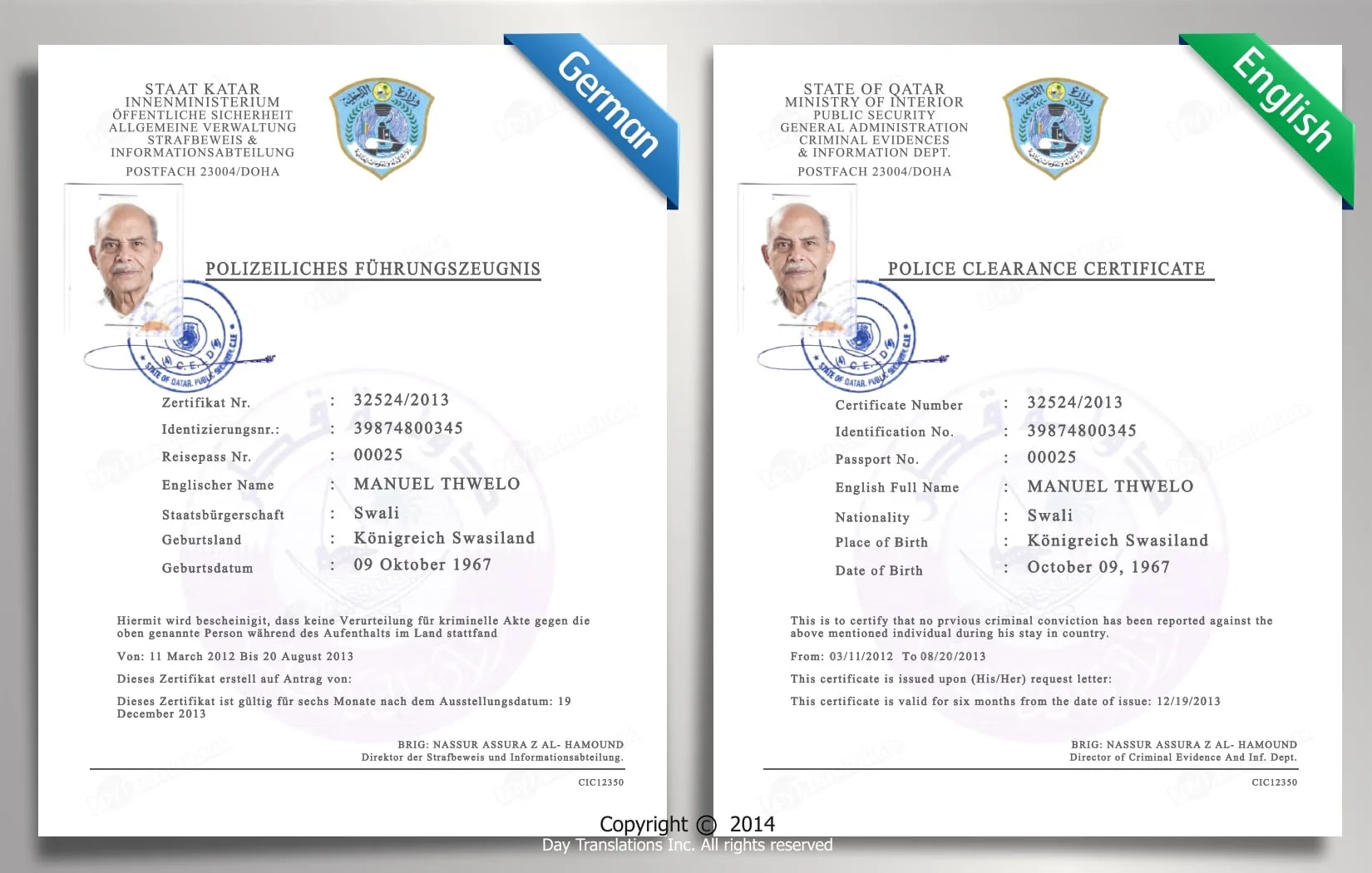
A German police clearance certificate beside its certified English translation, the round seals, the stamp across the photo and the signature all rendered on the English page.

Certification Wording That Misses a Requirement

USCIS and the immigration courts ask for different statements. USCIS wants the translator to certify that the translation is complete and accurate, and that they are competent to translate.

Immigration court asks for more. The EOIR Immigration Court Practice Manual, Chapter 3.3(a) says the certification “must be typed, signed by the translator.” It must also include the translator’s address and telephone number. So a statement written only for USCIS falls short in court.

Our certificate format already carries those contact details, as the next section shows, which means one certificate serves both settings.

Translations Filed Without the Original-Language Copy

Officers and credential evaluators read the translation against the source. File the translation alone, and they have nothing to compare, so the file waits while they ask for the original. Universities and evaluation services expect the original-language record next to the English version, and some reject an application that arrives with only one of the two.

Each certificate we issue names the source document it covers, which keeps the pairing clear even when a case file holds dozens of exhibits.

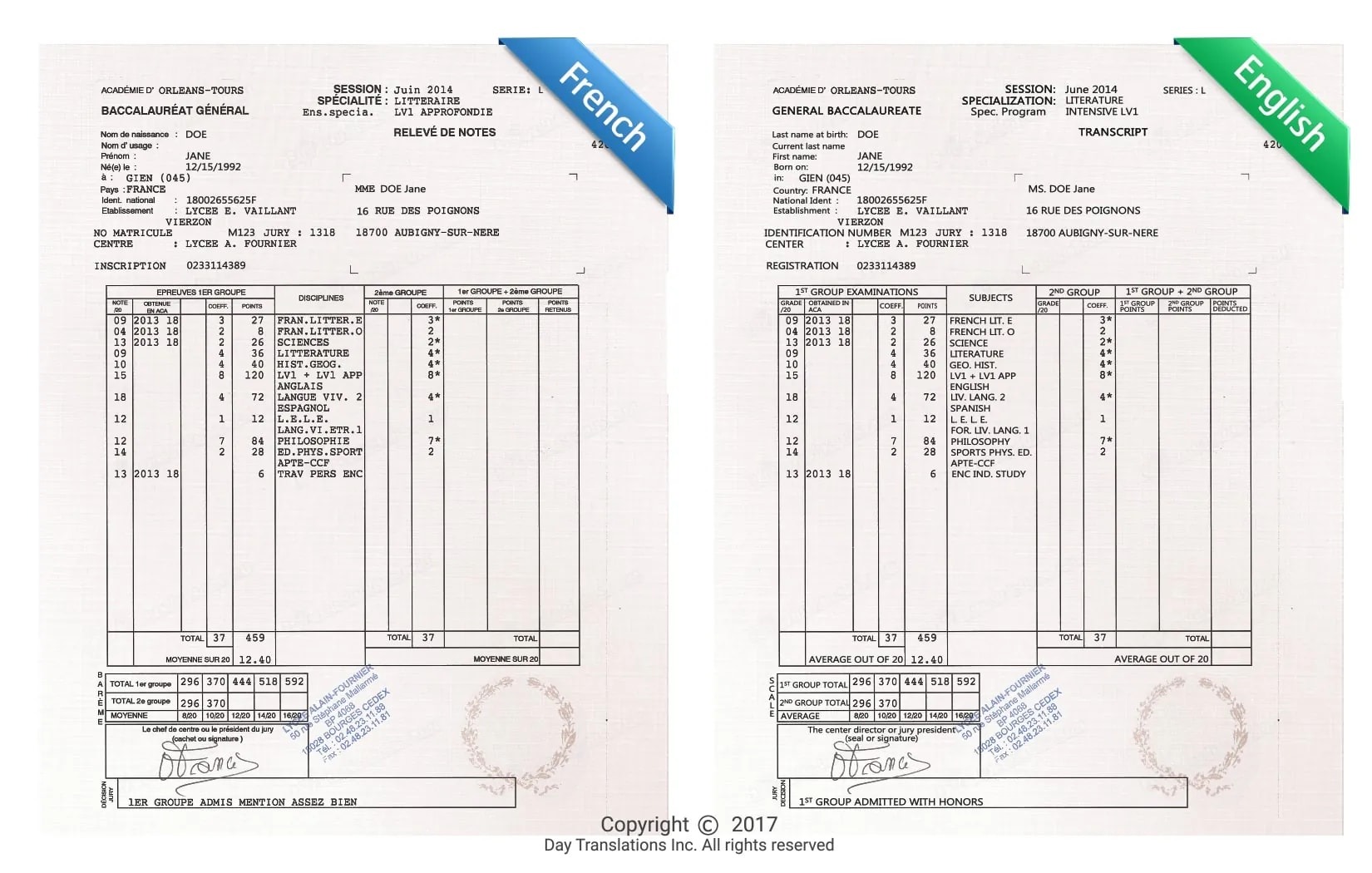
A French baccalaureate transcript beside its certified English translation, the original-language record and the English version kept together as universities and evaluators expect.

Certificates Signed by the Applicant or a Relative

Many universities and credential evaluators refuse translations prepared by applicants or their relatives. Passing USCIS doesn’t carry over to the next office, and the applicant finds out only after the deadline. Every certificate we issue carries the signature of a professional translator from our team, so nobody at the next office has to ask who translated the file.

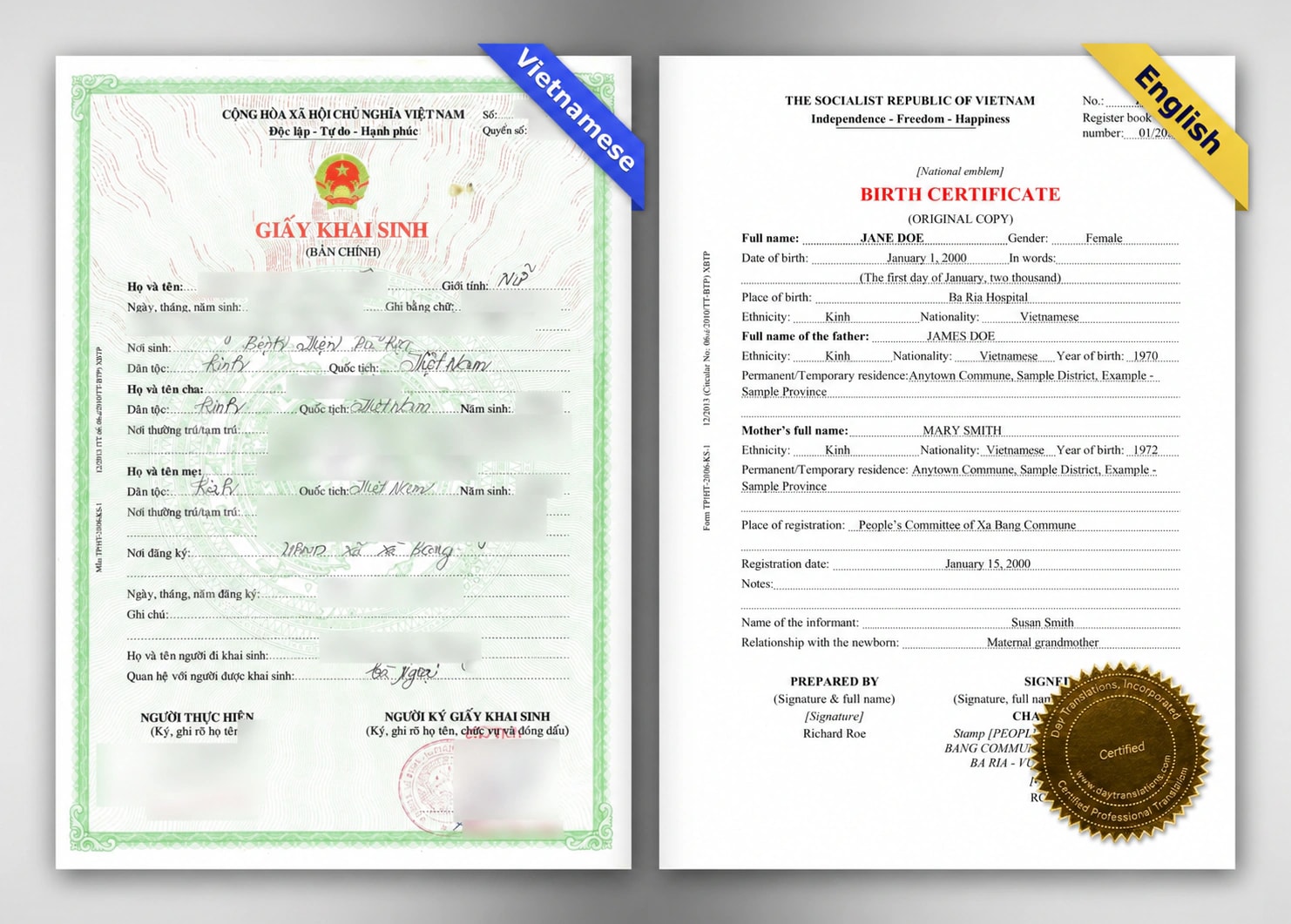
A Vietnamese birth certificate beside its English translation, certified by our professional translator and finished with a gold Certified seal.

Machine Output Presented as a Certified Translation

Free tools and unchecked machine drafts change meaning, mistranslate legal terms, and switch terms from one page to the next. Reviewers on vendor sites describe court judgments and personal records they paid to translate twice because of it. Any translator who signs over that output carries the error straight into the file. Machine translation plays no part in our certified documents. On every order, a native-speaking professional translator works from your source file.

Names Spelled Differently from One Document to the Next

Spell a surname one way on a birth certificate and another way on a marriage certificate, and an officer asks a simple question: do both records belong to the same person? The question comes in writing, and the answer costs weeks. Transliteration causes many of these gaps, because Arabic, Chinese, Cyrillic, and Devanagari names have more than one accepted Latin spelling. Our translators use the passport spelling you send with the order, so every name reads the same across the whole file.

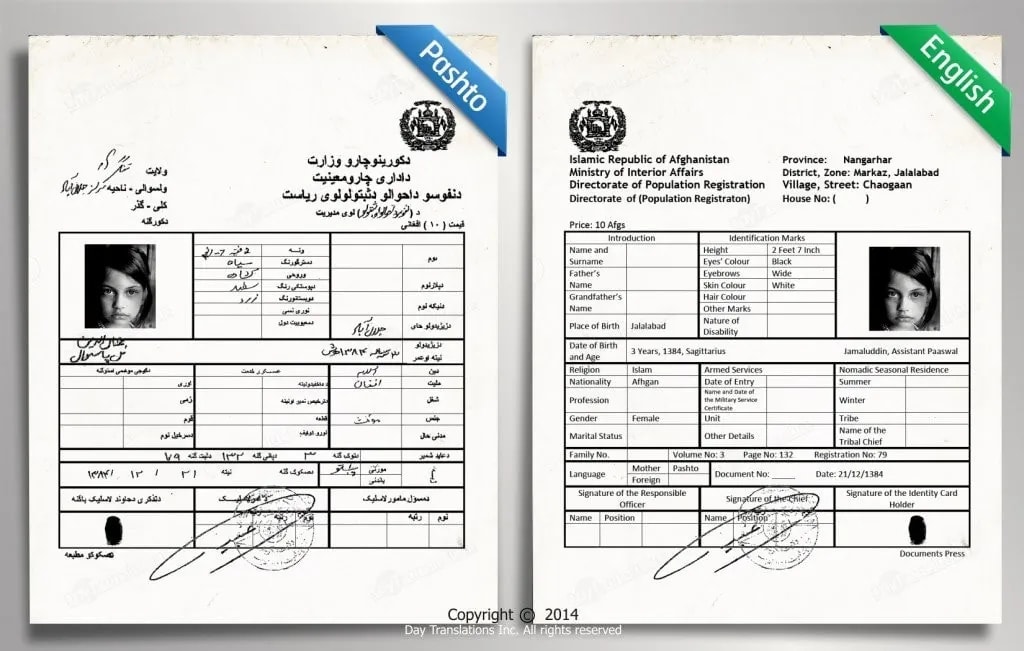
An Afghan population registration in Pashto beside its certified English translation, each name written in Arabic script set out in one consistent Latin spelling.

What Every Certified Translation Includes

Each translation we return is ready to attach to the petition, motion, or credential file it supports. Four parts make it hold up when an officer or evaluator checks it.

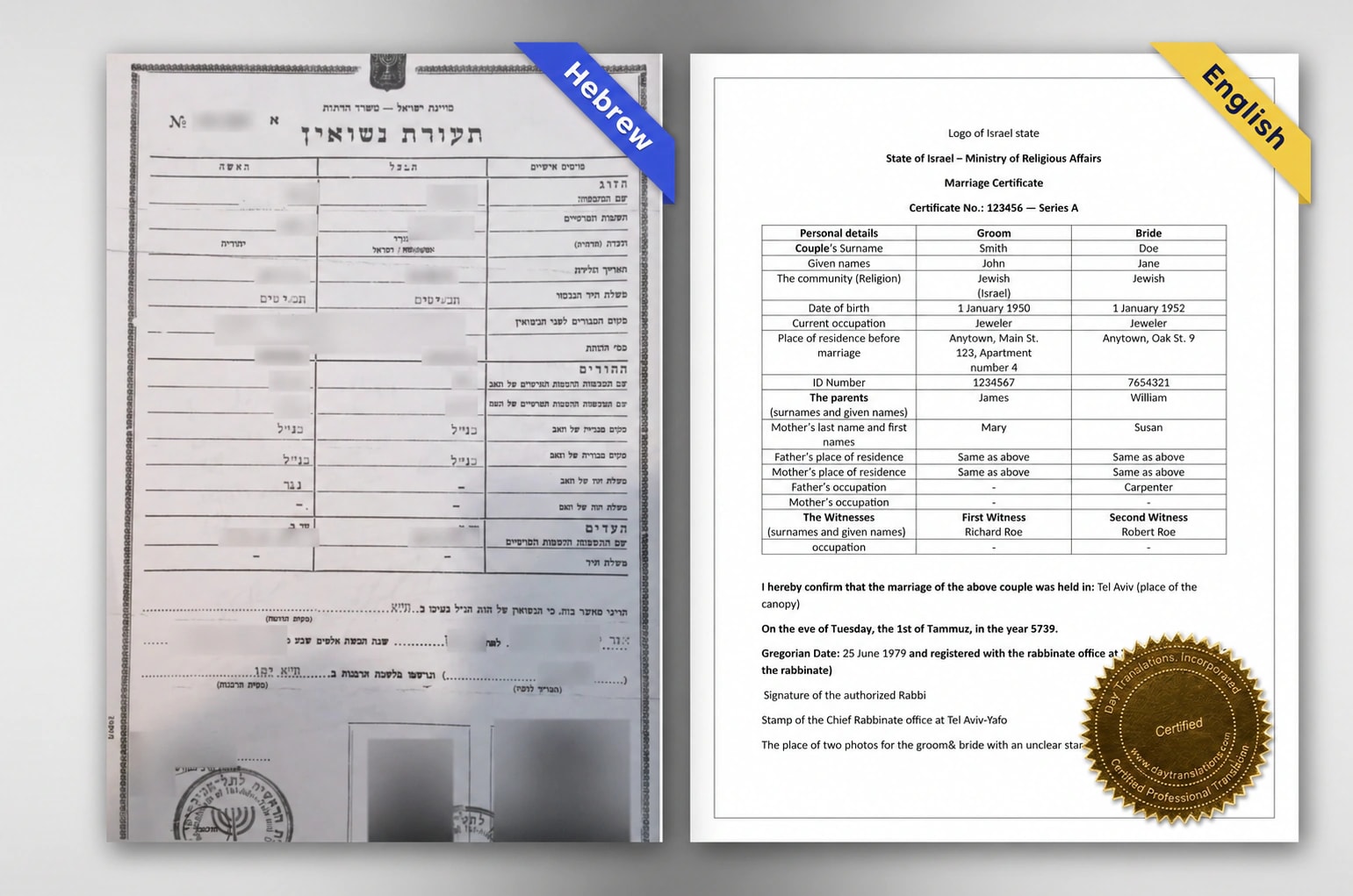
  1. A Hebrew marriage certificate beside its certified English translation, the English page finished with the translator's certification and a gold Certified seal.

    Signed Certificate of Accuracy

    The translator signs a Certificate of Accuracy on Day Translations letterhead. The certificate identifies the document and its language, confirms that nothing was left out or changed, and carries the translator’s signature and the date. With the credentials described next, it covers every element the American Translators Association lists as the minimum. It also matches what 8 CFR 103.2(b)(3) asks of the translator.

  2. Translator Credentials and Contact Details

    Each certificate gives the translator’s full name, credentials, and contact information. Immigration court needs the address and telephone number, and an officer who wants to verify a line knows exactly whom to contact. Without them, the reviewer has a signature and nothing to check it against.

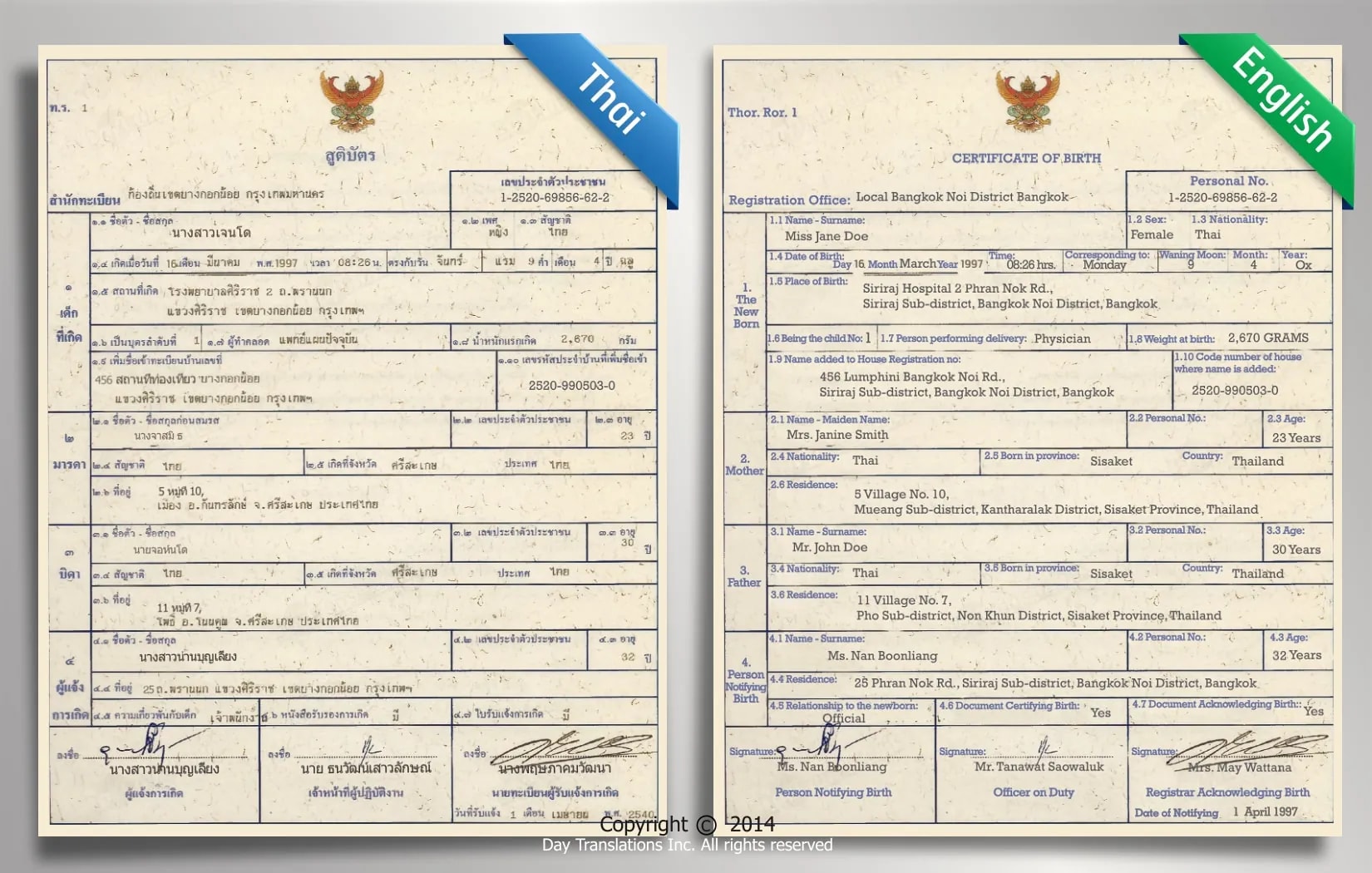
  3. A Thai birth certificate beside its certified English translation, every field, seal and signature block in the same place on the English page.

    Mirror-Image Formatting

    Our translators rebuild the layout of the source. Tables, seals, borders, signature blocks, and field labels appear in the same place in the English version. That way, an officer comparing two birth certificates side by side finds each entry where they expect it.

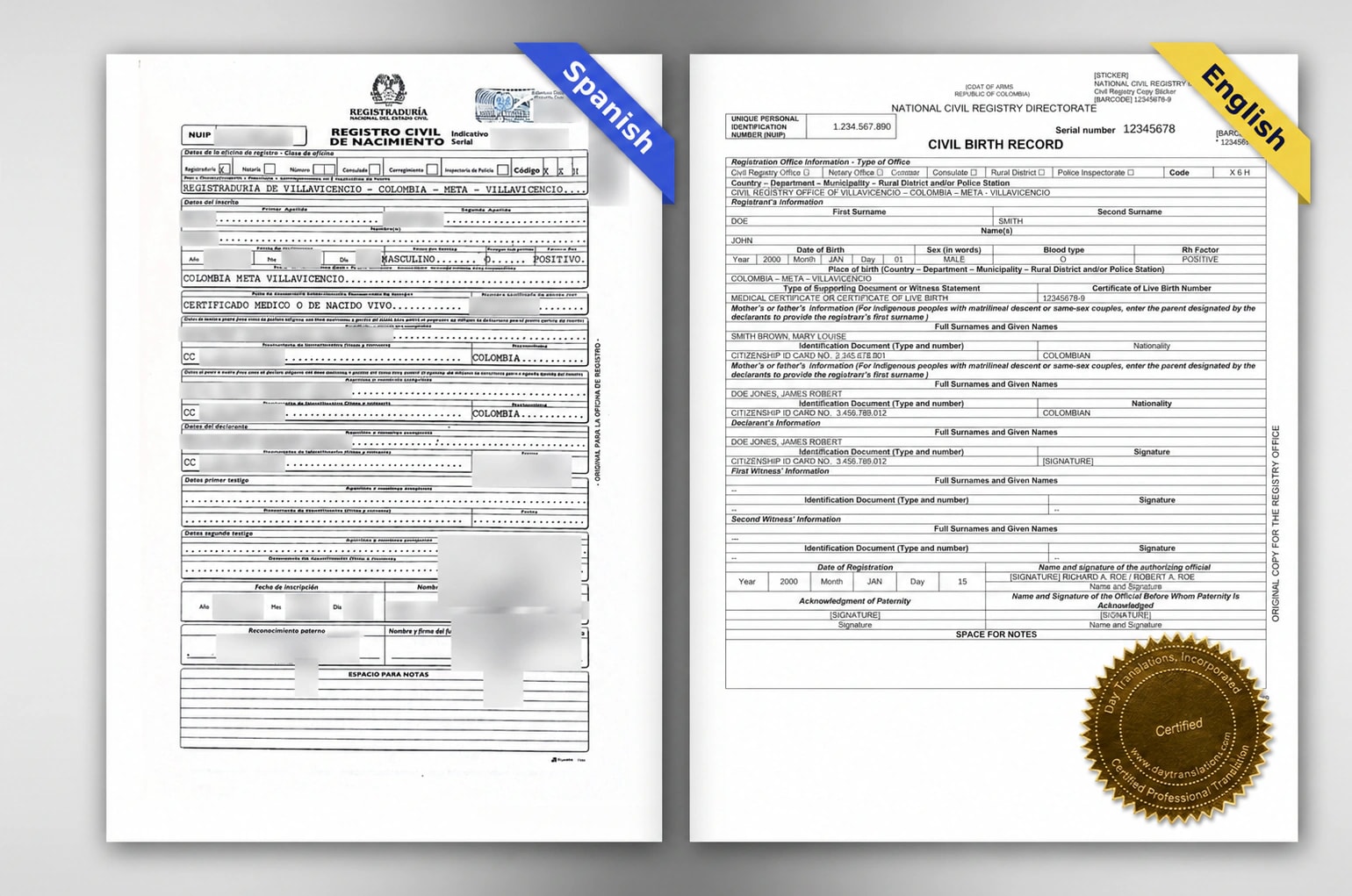
  4. A Colombian civil birth record beside its certified English translation, the certification and the translation delivered together as one file with a gold Certified seal.

    Secure PDF, with Hard Copies on Request

    Your translation comes as a secure, uneditable PDF, ready for electronic filing. The certificate and the translation travel as one file, so no page can be swapped or edited after the translator signs. When a court, consulate, or university wants paper, we print the set and ship it with tracking.

Certified or Standard Translation: Which One a File Needs

Certified translation fits any document an outside authority will read, whether that’s USCIS, a court, a consulate, a university, or a licensing board. That authority relies on the translator’s signed statement, so the certificate must be included.

FeatureCertified translationStandard translation
Who reads itUSCIS, courts, consulates, universities, licensing boardsYour own team, counsel, or business partners
Signed Certificate of AccuracyIncludedNot included
File you receiveSecure, uneditable PDFEditable file
LayoutMirror image of the sourceClean, readable layout
Price basisPer pagePer word

Certified Document Translation for Each Team

Certified translation for business works differently from a single personal order, because each team brings its own documents, receiving authority, and deadline. Here’s what we translate for each one.

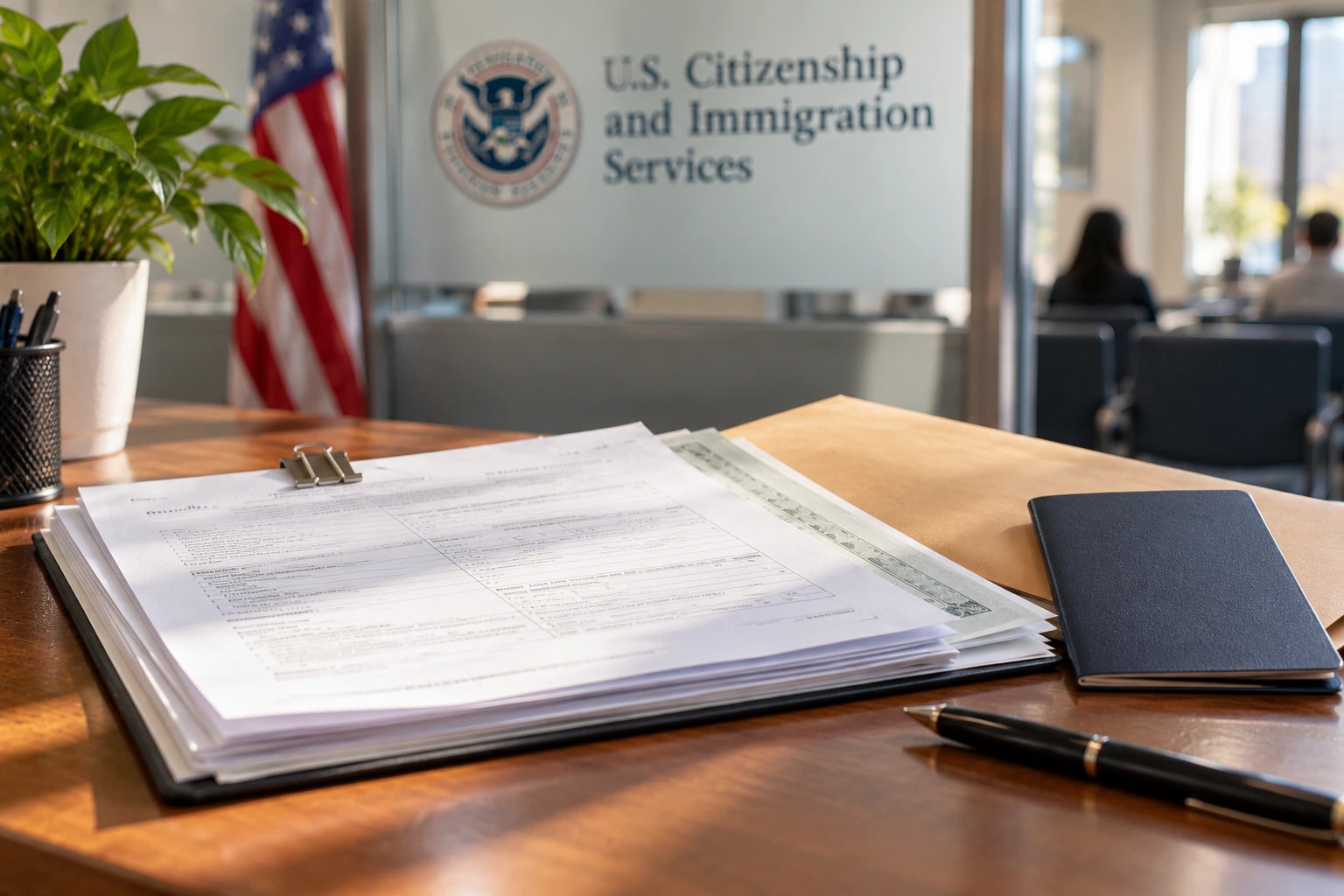
  1. An application packet and a passport on a desk at a U.S. Citizenship and Immigration Services office, the kind of filing an immigration law firm sends with certified translations.

    Immigration Law Firms

    Immigration cases rarely come down to one document. One family-based petition alone calls for birth, marriage, and divorce certificates, police certificates, and court orders, sometimes from two or three countries. Asylum cases add identity documents, news reports, and medical records from the home country.

    The DHS fiscal year 2023 report on lawful permanent residents counts 1,172,910 new lawful permanent residents that year. About 52% of them adjusted status from inside the United States. USCIS reviews those Form I-485 applications and the translated evidence behind them.

    Your whole case file goes through as one order. For filings that go only to USCIS, our USCIS certified translation team handles the form-by-form detail.

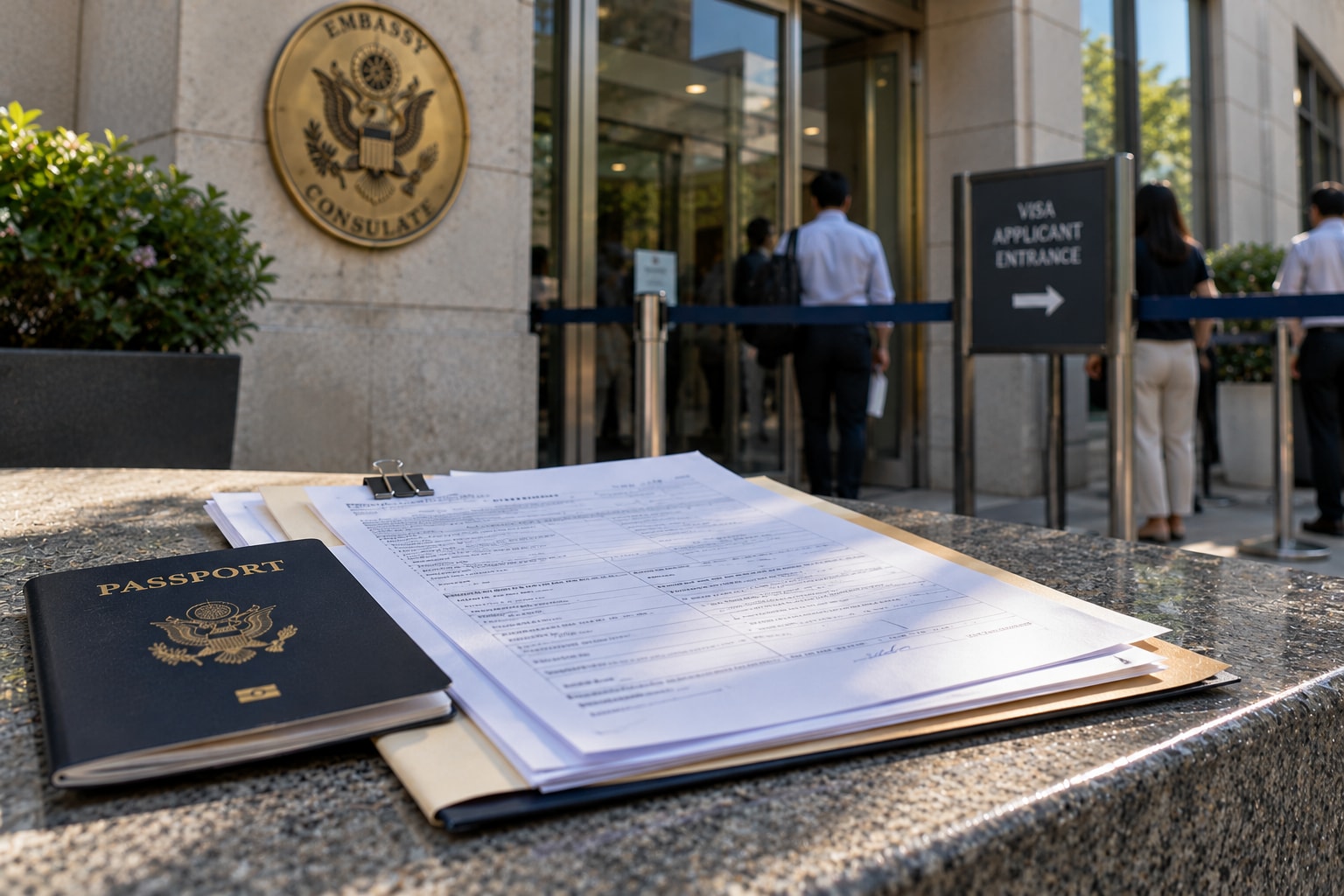
  2. A passport and visa paperwork on a ledge outside an embassy's visa applicant entrance, the relocation documents HR and global mobility teams have translated and certified.

    HR and Global Mobility Teams

    Foreign-born workers made up 19.1% of the US civilian labor force, according to 2025 Bureau of Labor Statistics data. Their relocations, work visa petitions, and employment checks bring diplomas, transcripts, and family records to the HR desk. Any H-1B petition built on a foreign degree needs the diploma and transcript translated under the same USCIS rule.

    Every employee and dependent gets the same certificate package from us. Your mobility team forwards each file to immigration counsel without reformatting it.

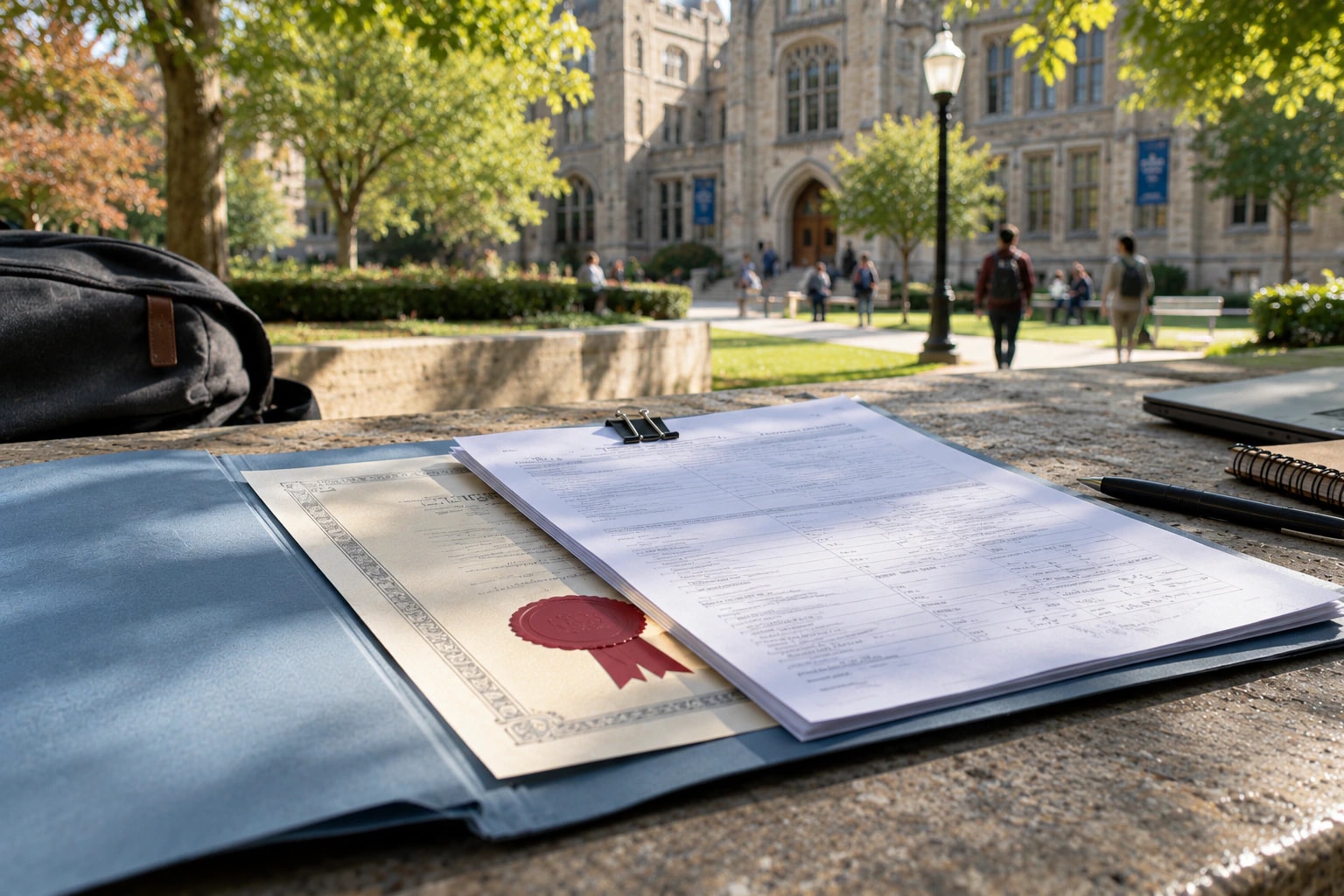
  3. A transcript with a red seal and a stack of records in a folder on a campus bench, academic documents certified in translation for admissions and credential evaluation.

    Universities and Credential Evaluators

    Admissions offices and credential evaluation services read transcripts and diplomas line by line, and many expect a word-for-word translation in the original layout. Evaluators compare foreign coursework with US standards, so one dropped course title or misread grade changes the result.

    Our full, literal translation and mirror-image formatting meet that expectation. Course-by-course evaluations rely on every title and credit count, which is why we translate each one exactly as printed. For large batches of academic records, our transcript translation team takes on the volume.

  4. A sealed diploma and a stack of records in a folder beside a stethoscope on a clinic desk, medical credentials translated for hospital hiring and licensing boards.

    Hospitals and Medical Licensing

    Hospitals need patient records, consent forms, and discharge documents translated for care and for legal files. Internationally trained physicians, nurses, and pharmacists submit diplomas and licenses to credentialing bodies, which check every date and institution name against the source. Both kinds of file carry protected health information or personal data.

    Those files stay under the security controls listed further down this page. Clinical content outside certified work goes to our medical translation specialists.

  5. A tabbed exhibit binder and a legal pad on counsel's table in an empty courtroom, litigation exhibits prepared with certified translations.

    Corporate Legal and Litigation

    Contracts, corporate records, powers of attorney, and foreign judgments need certified legal translation before a court or counterparty accepts them. Every defined term has to read the same way in each exhibit that cites it. Foreign judgments offered for recognition need every page, including the court’s seal and the certificate of finality.

    Broader legal work, from litigation exhibits to agreements that won’t be filed, goes to our legal translation services team.

What USCIS, Immigration Courts, and Other Authorities Require

The receiving authority decides what the certificate must say, and what else goes with it, such as a notary stamp or an apostille. This table compares the rules we prepare for most.

AuthorityRuleWhat the translation and certificate need
USCIS8 CFR 103.2(b)(3)Full English translation, plus the translator’s certification of completeness, accuracy, and competence
Immigration courtEOIR Practice Manual, Chapter 3.3(a)Typed, signed certificate attached to the foreign-language document, with the translator’s contact details
Consulates processing immigrant visasState Department immigrant visa guidanceTranslation with a signed statement of accuracy and translator competence
Universities and credential evaluatorsEach institution’s own policyCommon requirements: word-for-word translation, the original layout, the original-language copy, and no self or family translation
Foreign authorities receiving US documentsHague Apostille Convention, Article 5Apostille on the public document, issued by the country where it originated
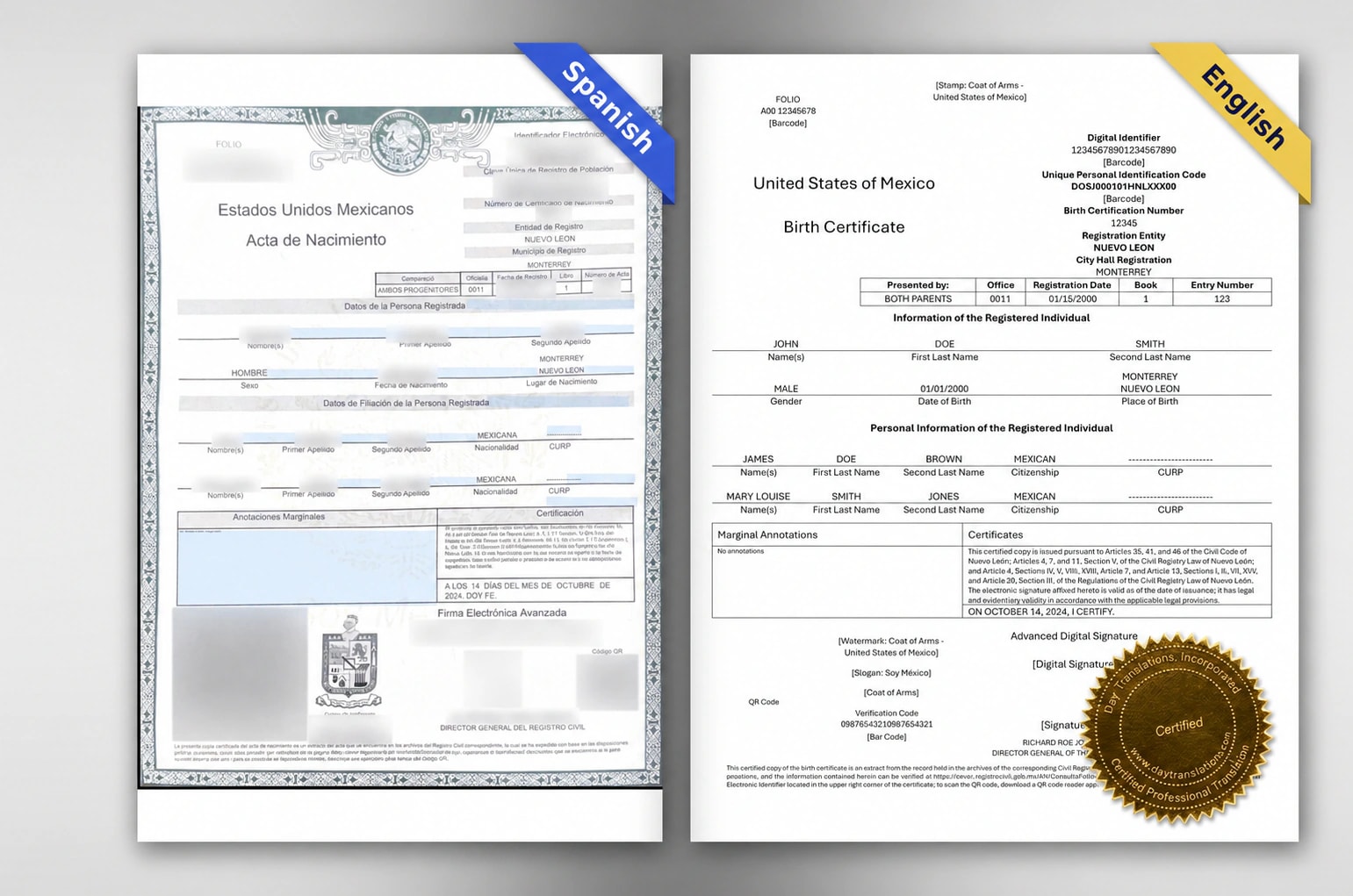
A Mexican birth certificate beside its certified English translation with a gold Certified seal, the kind of complete translation USCIS and the immigration courts expect.

For immigrant visas, the State Department’s guidance on supporting documents sets the rule for consular files. Consulates outside the United States apply it alongside any local instructions.

The USCIS Policy Manual adds nothing to the regulation here. Its translations section still reads “Reserved,” so 8 CFR 103.2(b)(3) is the standard every USCIS translation has to meet.

State courts and federal district courts set their own translation rules. Some ask for a sworn declaration or a notarized signature. When a local rule calls for a sworn statement, our translation affidavit service adds one to the certificate.

How a Certified Translation Order Runs

We need three things with each file. Once your files arrive, four steps on our side take them to a signed certificate.

What We Need from You

  • Every page of each document, front and back, as a clear scan or photo.

  • The authority that will receive the translation, such as USCIS, a court, or a university.

  • The passport spelling of every name in the file.

What We Do Next

  1. We match a translator to the document type.

    The file goes to a native-speaking professional translator who works with that document type and language pair. Legal records go to legal translators, and academic files go to translators who work with academic records.

  2. Then a second qualified linguist reviews the translation.

    The reviewer reads it against the source for accuracy and completeness, including stamps, seals, and handwritten notes. Names, dates, and document numbers get checked line by line.

  3. The translator signs the Certificate of Accuracy.

    The signed certificate goes on our letterhead, attached to the translation it covers.

  4. You receive the secure PDF and hard copies when you order them.

    The files arrive ready for upload or mailing.

If your office files certified translations every month, our team can walk you through how repeat orders run for your caseload.

How We Protect Personal and Case Files

Your files carry passport numbers, medical histories, and case details. Our protection rests on the controls listed in our Trust Center. Every document and connection is encrypted, and access stays limited to the people assigned to your order:

A case file in its sleeve on a desk, the top certificate signed beneath an embossed seal, the way client documents stay sealed and accounted for.
  • Files encrypted with AES-256 at rest and TLS 1.3 in transit

  • Zero-trust architecture, with multi-factor authentication enforced

  • Role-based permissions with least-privilege access

  • EU data stored in the EU

  • NDA-bound workforce

  • Business Associate Agreement for HIPAA-covered entities

  • Security documents for verified organizations, sent within 1 to 2 business days of a request

Certified Translation Services FAQs

Send Your Next Certified Translation Order

Start with the documents you need certified this month, and we’ll send a quote before any work begins.

  • AES-256 at rest
  • TLS 1.3 in transit
  • MFA enforced
  • ATA Member
Carla is a Customer Support Representative dedicated to making multilingual communication seamless for healthcare, legal, government and global enterprises. She coordinates translation, localization and interpreting services in over 500 languages 24/7.Request a QuoteCarla Moxam